


Few sports in Kenya are enjoying the kind of rapid growth currently being witnessed in table tennis.
Once regarded as a recreational pastime, the sport has steadily transformed into one of the country’s fastest-rising disciplines, driven by increased grassroots development, international partnerships and growing global recognition.
Governed by the Kenya Table Tennis Association (KTTA), under the leadership of Andrew Mudibo, the sport has made tremendous strides through collaborations with international governing bodies to introduce table tennis in schools and informal settlements, nurturing a new generation of talented players.
Kenya’s growing reputation on the global stage was underlined last year when Nairobi was chosen to host the global Main Event for World Table Tennis Day, bringing together youth players, international delegates and local communities in a celebration of the sport.
Earlier, in 2023, the country successfully staged the prestigious International Table Tennis Federation (ITTF) Africa Cup at the Moi International Sports Centre, Kasarani, further cementing its place on the continental table tennis map.
In today’s edition of Know Your Sport, we take a closer look at the fascinating world of one of the fastest sports on the planet.
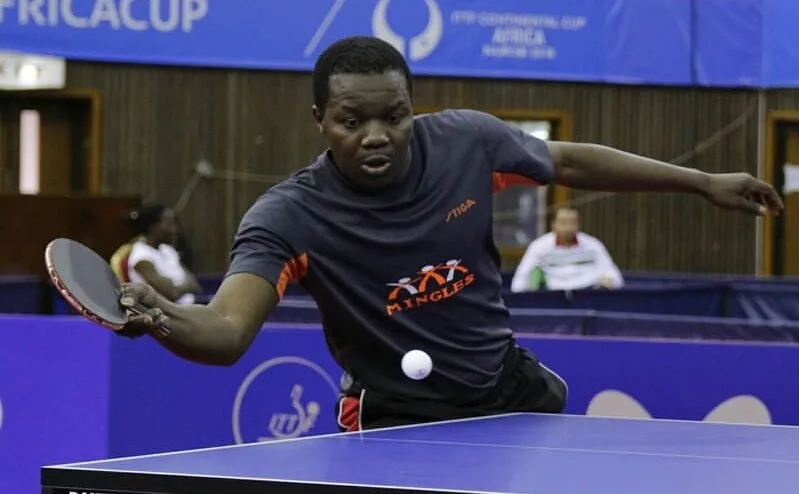
Table tennis, popularly known as ping-pong, is a high-speed indoor racket sport in which players rally a lightweight plastic ball across a net using specially designed paddles. Despite its compact playing area, the game demands explosive speed, razor-sharp reflexes and immense concentration, with rallies often unfolding in a matter of seconds.
The sport can be played in singles, where one player faces another, or in doubles, with two players competing on each side of the table.
Players use specially made paddles consisting of two main parts: a wooden or composite blade, usually constructed from five to seven layers of wood, and a rubber covering. The blade provides balance, control and flexibility, while the rubber generates the speed and spin that make the sport so exciting.
The game is played on a hard, rectangular table divided equally by a suspended net. An official competition table measures 2.74 metres (9 feet) long, 1.525 metres (5 feet) wide and stands 76 centimetres (2.5 feet) high.
Although the equipment appears simple, mastering table tennis is anything but easy. Success depends on exceptional hand-eye coordination, lightning-quick reactions, footwork and tactical awareness.
Players constantly employ techniques such as topspin, backspin, sidespin and powerful smashes to outwit their opponents and force mistakes.
The first player to reach 11 points wins the game, provided they hold a two-point advantage. If the score reaches 10-10, known as deuce, play continues until one player establishes a two-point cushion, with scores such as 12-10 or 15-13 deciding the winner.
Matches are commonly contested as the best of three, five or seven games, depending on the level of competition. Casual games are often played over three games, while major tournaments, including the Olympic Games, usually adopt the best-of-five or best-of-seven format.
Unlike some racket sports, every rally counts, meaning a point is awarded after each rally regardless of who is serving.
Players normally serve twice consecutively before the service switches to the opponent. However, once the score reaches deuce, service alternates after every single point until the game is decided.
Points are scored whenever an opponent fails to return the ball, allows it to bounce twice on their side of the table, strikes it into the net or sends it beyond the playing surface.
During a serve, the ball must first bounce on the server’s side before clearing the net and landing on the opponent’s side. Once the rally begins, players return the ball over the net after it bounces once on their side. In doubles, teamwork becomes crucial. The serving pair delivers two serves before service changes hands.
The player who received the previous serve then becomes the server, while the partner of the previous server takes up the receiving role. Players must also alternate shots during each rally, making communication and coordination essential.
Table tennis traces its origins to Victorian England in the 1880s, where upper-class families created it as an after-dinner parlour version of lawn tennis.
The sport quickly evolved from a social pastime into an organised international competition. Its rapid growth received a major boost with the formation of the International Table Tennis Federation (ITTF) in 1926, which established standardised rules and officially adopted the name “Table Tennis.”
Table tennis made its Olympic debut at the 1988 Seoul Games, initially featuring four medal events: men’s singles, women’s singles, men’s doubles and women’s doubles.
Beginning with the 2008 Beijing Olympics, the doubles competitions were replaced by men’s and women’s team events, a format that remains in use today.