



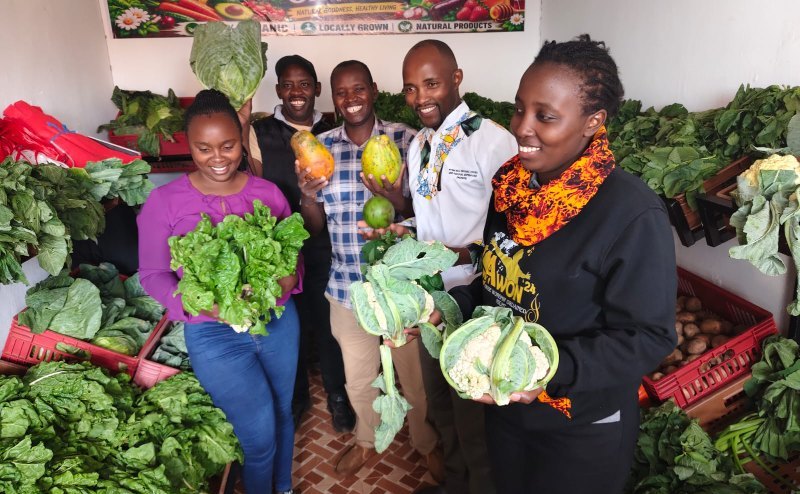
One year ago, a group of Nyeri residents came together with a simple goal: to produce healthy food while protecting the environment.
The members, who now operate under the banner of Nyeri Organic Herbs and Eco-fuel Enterprise (Nohefe), embarked on a journey into organic farming after undergoing training on agroecology.
This was after learning about the dangers posed by excessive use of agrochemicals to human health and the environment.
What began as a small initiative has since grown into a thriving venture. The 11-member group leased a one-acre farm where they cultivate vegetables, herbs and tubers using organic farming methods.
They also established a solar dryer at the home of one of the members, enabling them to preserve vegetables and herbs through drying before packaging them for sale.
The group’s products are now among those being sold at Nyeri’s first organic produce outlet, which was recently opened at Skuta area through support from development partners promoting agroecology.
Group chairperson Pauline Kariuki says the journey started while planting trees in Nyeri Hill Forest through a programme supported by Rodi Kenya.
“We learnt that if you take care of nature, it will take care of you and vice versa, and that’s when we started venturing into agroecology,” she said.
The members were introduced to value addition and soon realised that several indigenous plants growing around them could be transformed into marketable products.
One such plant was stinging nettle, locally known as hatha, which grows naturally in nearby forests. Instead of letting it go to waste, the group began harvesting, drying and packaging it for sale.
“We started by consuming the products ourselves, then our families and neighbours embraced them before we expanded to the Nyeri market,” Kariuki said.
George Boro, Pelum’s Nairobi and Central zonal coordinator, sampling some of the organic produce sold at the organic shop in Nyeri town on Saturday /ALICE WAITHERA
The group currently grows tomatoes, capsicum, coriander, kale, arrowroots, cassava and potatoes on the leased farm, with plans to expand production as demand grows.
Kariuki said the newly opened organic shop will provide a reliable market for their produce, while making it easier for consumers seeking healthy food to access certified organic products in one location.
“Our primary source of raw materials will remain our own farm because we do not want to sell products grown using harsh chemicals. We want to strengthen and promote organic farming, and that begins with us growing the crops ourselves,” she said.
The initiative is part of a wider push to promote agroecology across the country, with stakeholders increasingly encouraging farming methods that enhance soil health, conserve biodiversity and reduce dependence on synthetic inputs.
In recent years, the country has made significant strides in institutionalising agroecology.
In 2024, the government launched the National Agroecology Strategy for Food Systems Transformation 2024-33, a framework aimed at promoting sustainable food production, climate resilience and improved nutrition through nature-positive farming practices.
Several counties, including Murang’a, Kiambu, Vihiga, West Pokot and Nakuru, have developed policies and legal frameworks to support agroecological farming.
George Boro, Pelum’s Nairobi and Central zonal coordinator, said the progress being witnessed among farmers in Nyeri demonstrates the potential of agroecology to improve livelihoods while safeguarding the environment.
“When we first started the training, they were not producing much food through organic farming. However, they are now producing significantly more, and that is why we supported the establishment of this organic shop,” he said.
Pauline Kariuki, Nyeri Organic Herbs and Eco-fuel Enterprise (Nohefe) chairperson, weighs organic produce for sale to customers at the first organic produce shop in Nyeri on Saturday /ALICE WAITHERA
Pelum Kenya, a network comprising 67 member organisations across the country, has been working through Rodi Kenya to train farmers on agroecological production and enterprise development.
Boro said the shop will not only provide a market for produce but also serve as a one-stop centre where farmers can access bio-inputs and consumers can purchase healthy food products.
“Even hospitals are increasingly recommending organic foods because of their health benefits. This shop, therefore, benefits both the farmer and the consumer,” he said.
Peter Chege of Rodi Kenya said the organisation has been training small-scale farmers on organic agriculture and helping them identify alternatives to conventional farm inputs.
He said the opening of the outlet marks a major milestone because it allows farmers to move beyond production and participate directly in marketing.
“After producing enough food for their households, they have gone a step further and opened the first organic food shop in Nyeri, where they will sell products grown through organic farming methods,” Chege said.
Rodi Kenya currently works with farmers and youth groups in 16 counties and hopes to replicate similar models elsewhere as more communities embrace agroecology.
The organisation plans to support the establishment of additional organic produce outlets in Karatina, Mukurweini and Othaya should production continue to increase.
The youth could not hide their joy after customers streamed into the outlet minutes after its launch, validating their hope that Kenyans are increasingly willing to embrace food produced in harmony with nature.