



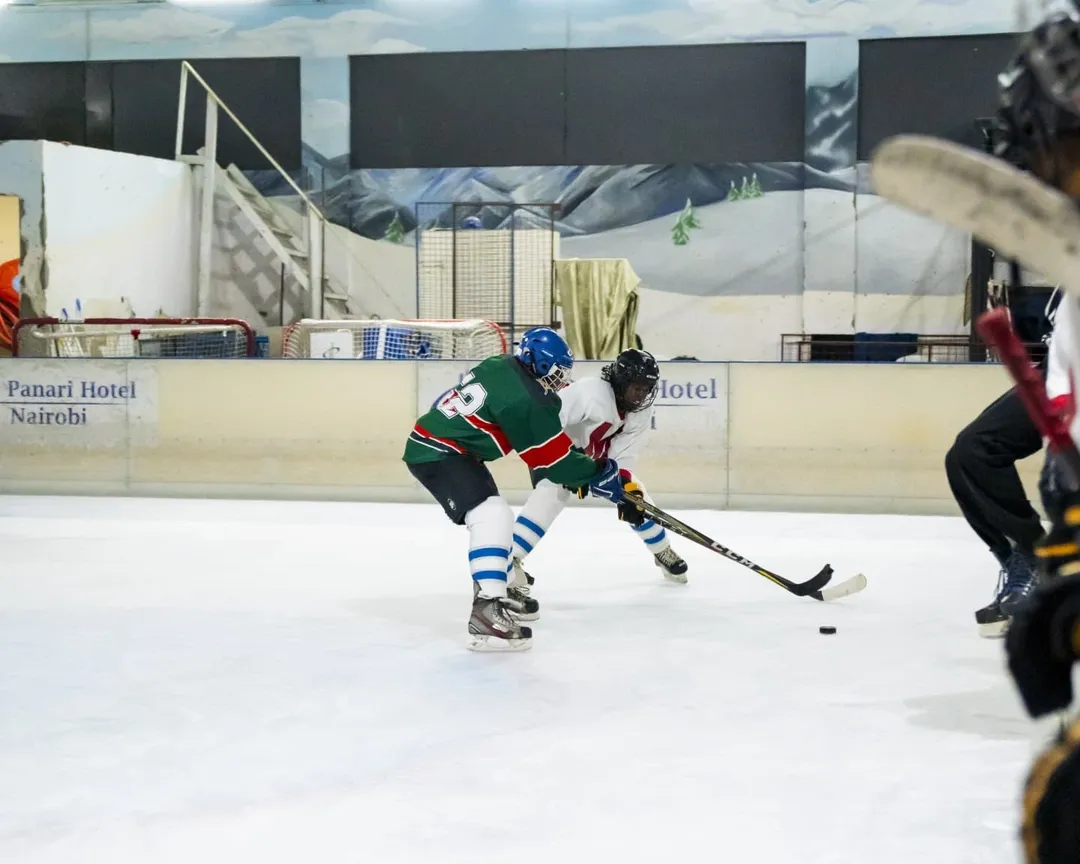
From the chill of the rink at Nairobi’s Panari Hotel, ice hockey is carving out its own lane in Kenya, fast, fierce and impossible to ignore.
In today’s segment, we delve into ice hockey, what it is and how it is played. Ice hockey is a high-octane team sport played on ice, where speed meets precision and physicality blends with finesse.
Two teams, each with six players (five skaters and a goaltender), battle to drive a hard rubber puck into the opponent’s net using curved sticks.
The game unfolds on a rectangular ice surface known as a rink, built to either National Hockey League (NHL) dimensions (200 by 85 feet) or international/Olympic size (60 by 30 metres).
The rink is enclosed by boards and divided into three key zones by two blue lines and a central red line, each zone shaping the rhythm of play.
At either end lies the defensive zone, where teams shield their goal, while the opposite end forms the attacking zone, where goals are hunted.
Sandwiched in between is the neutral zone, a transitional battleground where possession is won and lost. Guarding each net is the goal crease, a semi-circular sanctuary reserved for the goaltender, crucial for both protection and control.
Matches are played over three intense 20-minute periods. If teams are locked level, the drama spills into sudden-death overtime or even a shootout.
Each side typically deploys three forwards, made up of a centre and two wingers, alongside two defenders and a goalkeeper. While the forwards drive the attack, the defenders anchor the backline, and the goalie stands as the last line of resistance.
Ice hockey is unapologetically physical. Body checking (using the body to dispossess an opponent) is a legal and strategic weapon, demanding players to be both tough and technically sharp.
Athletes are heavily armoured with helmets, pads and gloves to withstand the collisions.
But beyond the brute force lies a game governed by strict rules. Offside is called when an attacking player crosses the opponent’s blue line before the puck, halting forward momentum.
Icing, on the other hand, occurs when the puck is blasted from behind the centre line across the opponent’s goal line untouched, resulting in a stoppage and face-off deep in the offending team’s zone.
Discipline is equally critical, with infractions such as tripping or boarding sending players to the penalty box, temporarily reducing their team’s numbers and handing the opposition a power play.
The sport traces its roots to 19th-century Canada, with the first organised indoor match staged on March 3, 1875, at Montreal’s Victoria Skating Rink.
Its global footprint expanded with the formation of the International Ice Hockey Federation (IIHF) in 1908, paving the way for structured international competition.
Ice hockey made its Olympic bow at the 1920 Summer Olympics, before becoming a staple of the Winter Games from 1924 in Chamonix, France. Back home, the sport’s Kenyan chapter began in 2005 with the opening of the Solar Ice Rink at Panari Hotel in Nairobi.
What started as a novelty quickly gathered pace, evolving from informal sessions into organised competition. The formation of the Kenya Ice Lions in 2016 marked a turning point, giving the sport identity and direction.
Governance soon followed with the establishment of the Kenya Federation of Ice Sports (KEFIS) in 2019, tasked with nurturing talent and growing the game locally. A landmark moment arrived in 2024 when Kenya earned associate membership to the IIHF, opening the door to the global stage.