



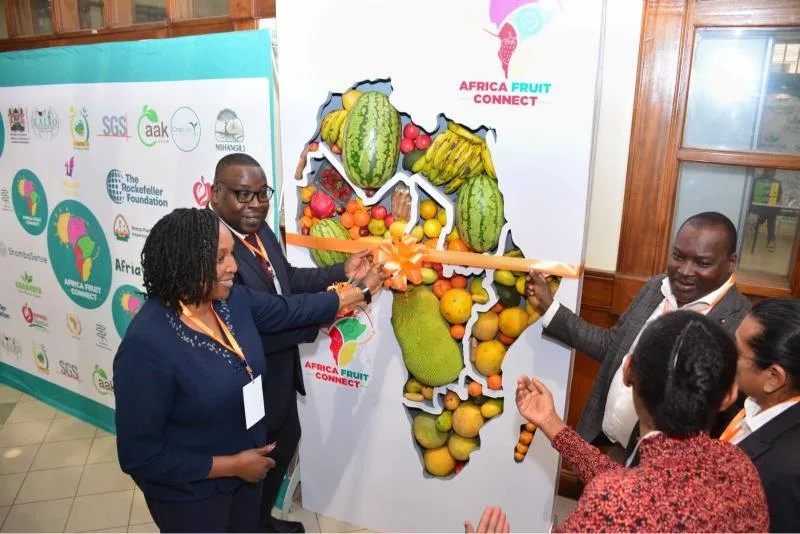
Kenya and other African countries need to look beyond exporting raw fruits and invest more in local consumption, processing and intra-African trade to unlock the full potential of the continent’s growing fruit economy, an African Union official has said.
Dr Saliou Niassy, coordinator at the African Union Inter-African Phytosanitary Council (AU-IAPSC), said Africa was gaining ground in the global fruit market, with its share of global fruit exports rising from 7.2 per cent to 8.6 per cent.
He said exports had grown by 7.9 per cent annually since 2019, but urged African countries to strengthen domestic and regional markets and add value to fruits before exporting them.
The call is particularly relevant to Kenya, whose fruit exports rose from 81.9 million tonnes in 2019 to 225.4 million tonnes in 2024, while the value of exports increased from Sh13.2 billion to Sh41 billion, according to Kenya National Bureau of Statistics (KNBS) data.
Speaking during the official opening of Africa Fruit Connect 2026 in Nairobi, Niassy noted that the growth was concentrated in a few countries, with about 80 per cent of Africa’s fruit export value coming from South Africa, Egypt and Morocco.
“The question before us is not simply how Africa can export more fruit, but how we can enable many more African countries, farmers and enterprises to participate in this growth,” he said.
Niassy said Africa’s fruit ambitions should go beyond supplying international markets to ensuring that more African families have access to diverse, affordable and nutritious fruits.
“Our ambition cannot be limited to putting more African fruits on supermarket shelves in Europe, Asia or the Middle East. We must also put more diverse, affordable and nutritious African fruits on the tables of African families,” he said.
He said value addition remained another major gap, noting that about 85 per cent of Africa’s fruit exports by value are fresh, while processed products account for only about nine per cent.
Niassy said increasing processing would help countries capture more value from their fruit production while creating opportunities for farmers, processors and other businesses along the value chain.
He also warned that stronger plant-health systems would be critical if Africa is to build a competitive fruit industry.
“Fruit flies, false codling moth and other pests and diseases do not respect national borders. One pest outbreak can affect an entire value chain, close an export market and undermine years of investment by farmers and businesses,” he said.
He called for stronger surveillance, diagnostics, pest-risk analysis, early warning systems, traceability, certification, electronic phytosanitary certification, integrated pest management and greater regional cooperation.
Niassy said Africa had the fruits, farmers, knowledge, innovation and markets needed to build a stronger fruit economy but lacked sufficient connections between different parts of the value chain.
“What we have often lacked is connection between production and markets, between science and business, between plant health and trade, between national systems and continental ambitions, and between African farmers and African consumers,” he said.
The three-day Africa Fruit Connect 2026 conference is being held under the theme “Connecting Africa’s fruits to Africa and the world”.
According to Loise Wachira, director of Africa Fruit Connect, the conference seeks to place Africa’s fruit economy at the centre of trade, investment and innovation.
The event has brought together producers, researchers, exporters, traders, investors, processors, policymakers, financial institutions, technology providers and development partners from across the continent.
Wachira said Africa was home to more than 800 indigenous fruit species, but its contribution to global fruit exports remained below five per cent.
She said billions of dollars in potential value were also lost across the fruit value chain, while a significant share of the continent’s fruit is traded in raw form with limited value addition.
“This is not a production problem. It is a systems, market and investment gap,” Wachira said.
She said the global fruit sector, valued at approximately $614 billion (about Sh80 trillion), was being driven by growing demand for healthy, nutritious and sustainably sourced foods.
Africa Fruit Connect 2026 aims to turn the continent’s fruit diversity and production potential into stronger businesses, higher farmer incomes, increased trade and greater value addition.
The platform is also seeking to promote partnerships, trade and cross-learning while advancing research and innovation, strengthening phytosanitary systems, improving market access and unlocking investment in climate-resilient fruit value chains.
The conference comes as African countries seek to deepen intra-African trade, create jobs, improve food and nutrition security and build more resilient agricultural value chains.
“Africa has the diversity, resources and talent to build a globally competitive fruit economy. The opportunity now is to connect the different parts of the value chain and move from potential to commercially sustainable action,” Wachira said.