
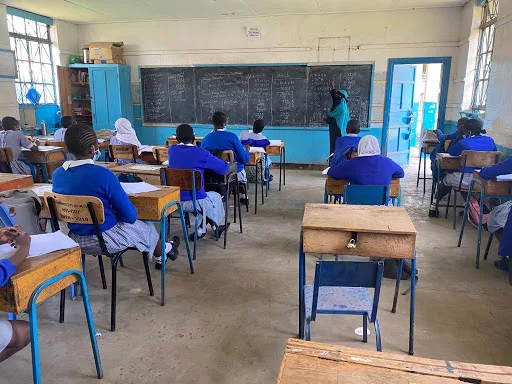
Debate over whether schools have received capitation has taken centre stage as learners reopen for the third term, despite government assurances that Sh18 billion was disbursed last week.
Speaking at AIC Makutano in Taita Taveta county on Sunday, President William Ruto dismissed claims by the opposition that the education sector was in limbo, saying the government has been releasing capitation funds ahead of school opening dates since January.
“Those spreading lies that schools are in debt due to lack of funds are behind schedule. From January this year, schools have been receiving funding before they open,” Ruto said.
“Previously, money used to follow one to two months after children open schools, but I have said that has to change. Starting January this year, money goes first, children follow later. Even now, money to educate our children in third term, Sh18 billion was sent last week.”
Despite the assurance, school administrators and teacher unions say institutions are reopening under intense financial pressure caused by delayed and inadequate capitation.
They warn that basic operations and examination preparations could be affected by persistent funding shortfalls, leaving schools with little option but to ask parents to meet the cost of essentials such as food, electricity, water, transport and learning materials.
“The schools are suffering debts right now,” Kuppet deputy secretary general Moses Nthurima said, terming the government’s assertion that funds have been released a rumour.
“There’s a rumour that about Sh3,000 has been released to [schools], but our spot checks from the principals, the money has not hit the accounts,” Nthurima told Citizen TV.
At nine weeks, the third term is the shortest in the academic calendar but arguably the most demanding.
Schools must dedicate much of their resources and time to completing the syllabus, preparing candidates for national assessments and KCSE examinations while maintaining normal teaching for other classes.
But repeated capitation shortfalls have pushed schools deeper into supplier debt, forcing administrators to increasingly rely on credit.
Some suppliers are now reportedly reluctant to continue providing goods and services to schools with mounting arrears.
Public secondary and senior school learners receive Sh22,244 annually, while junior school allocations stand at about Sh15,043 per learner.
The amounts are disbursed termly in a 50:30:20 ratio across the three terms, based on verified student registration data on the National Education Management Information System (NEMIS) portal.
For secondary schools, the termly allocations work out to Sh11,122 for the first term, Sh6,673 for the second term and Sh4,449 for the third term.
However, administrators say they have received approximately Sh16,500 per secondary school learner since the beginning of the year, leaving a shortfall of about Sh5,800 against the annual allocation.
Education officials say capitation shortfalls have left institutions with billions of shillings in outstanding funding arrears, raising concerns that the situation could hamper preparations for KPSEA, KJSEA and KCSE.
“Our course of action is to ask the parents to prepare to pay for the education of the learners,” Nthurima said.
Ahead of the reopening of schools for the first term on January 5, the government said it had released Sh44.2 billion, representing 50 per cent of the annual allocation.
At the beginning of May, it announced the release of a further Sh23.4 billion ahead of second-term school reopening for Free Primary Education, Free Day Junior School Education and Free Day Secondary Education.