



Kenya is looking to young entrepreneurs to help strengthen its food system as climate change, rising demand and geopolitical tensions expose the country’s dependence on imported food and agricultural inputs.
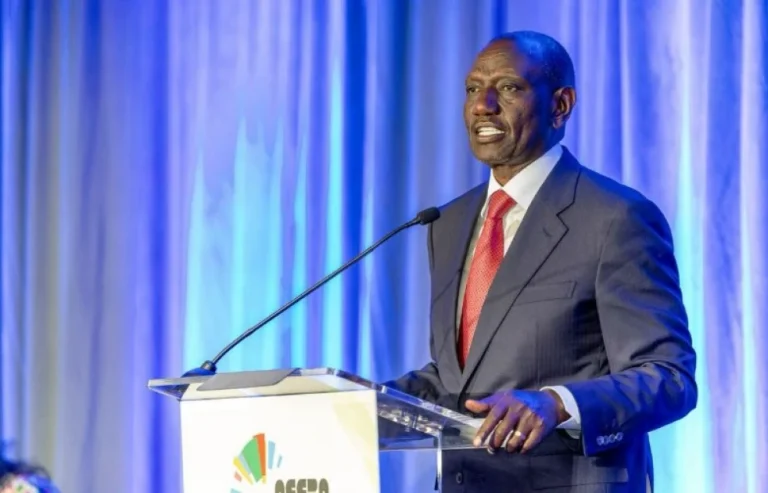
County governments, working with the Council of Governors (CoG) and the Alliance for a Green Revolution in Africa (AGRA), have launched the Model County Youth in Agrifood Systems Strategy, which seeks to increase young people’s participation across the food value chain.
The strategy comes as Kenya faces growing pressure to produce more food locally and reduce its exposure to global supply disruptions.
Already the country is staring at a potential humanitarian crisis as deepening global aid cuts threaten the country’s ability to prepare emergencies like the forecast El Niño season
Humanitarian agencies warn that shrinking donor support is already straining efforts to tackle hunger, support refugees and prepare for climate-related disasters, raising fears that millions of vulnerable Kenyans could be left exposed if heavy rains strike as forecast.
Kenya Red Cross said funding from the United States alone has fallen by about 40 per cent. The US has traditionally contributed between $350 million (Sh45.2 billion) and $400 million (Sh51.6 billion) annually to support humanitarian programs in Kenya.
With the population of 55 million, increasing demand for food and putting pressure on farmers and food businesses to raise production, the agriculture stakeholders say challenge remains keeping prices affordable.
The new county strategy seeks to make young people part of that response not just as farmers, but as entrepreneurs operating across the food economy.
It identifies opportunities in agricultural technology, mechanisation, logistics, input distribution, food processing, storage, aggregation, marketing, financial services and climate-smart agriculture.
“Young people must remain at the centre of our development agenda, and this strategy provides a practical pathway to gainful livelihoods, sustainable development, and scalable economic opportunities,” said Council of Governors chief executive officer Mary Mwiti.
AGRA director for policy and state capability Boaz Keizire said the organisation would work with counties to turn the strategy into businesses and jobs.
The stakeholders said, the approach reflects the wider challenge of youth employment in Kenya. With nearly three quarters of the population below 35, the country needs new sources of jobs and income as formal employment opportunities remain limited.
Agriculture contributes about 24 per cent of Kenya’s gross domestic product, while about 72 per cent of the population derives its livelihood directly or indirectly from the sector, according to the Kenya National Bureau of Statistics.
Yet domestic production falls well short of demand for some key commodities, Kenya produced about 311,000 tons of wheat in 2024 against estimated consumption of 2.25 million tons, according to the Agriculture and Food Authority (AFA). The country imported about 1.81 million tons to bridge the gap.
The dependence continued into 2025, with wheat imports reaching 555,719 tons in the first quarter, up seven per cent from 519,760 tons in the same period a year earlier.
Kenya is similarly exposed in the edible-oil market. The Ministry of Agriculture estimates that the country imports about 95 per cent of its annual edible-oil consumption of roughly 900,000 tons, with palm oil accounting for most of the imports.
AFA data shows Kenya imported 829,236 tonnes of oil-palm products worth Sh114.96 billion in 2024.
The heavy reliance on imports leaves consumers and businesses vulnerable to disruptions in global markets. Tensions in the Middle East have already disrupted shipping routes and raised concerns over the cost of transporting food and agricultural inputs.
The Food and Agriculture Organization has warned that prolonged disruption around key maritime routes could increase the cost of food, fuel and farm inputs. Kenya and other countries in the region also rely heavily on the Middle East for fertiliser supplies.
They argue that this has made strengthening domestic production more urgent, particularly as climate variability continues to affect farming.
A young entrepreneur does not necessarily need to own a farm to participate. They can provide mechanisation services, aggregate produce from smallholder farmers, run storage or cold-chain businesses, process crops or connect farmers to markets.
Such businesses could also address one of Kenya’s longstanding problems: the gap between what farmers produce and what consumers and processors need.
The government is already increasing spending and investment in agriculture.
The 2026/27 Budget allocated Sh64 billion to the sector, with the government targeting higher productivity and improved food security.
The Ministry of Agriculture says maize production increased from 34 million bags in 2022 to 67 million bags in 2025, while maize imports fell from 9.9 million bags to 3.3 million bags over the same period.
Irrigation is also being expanded as the government seeks to reduce agriculture’s dependence on increasingly unreliable rainfall.
The 2026 Budget Policy Statement says only about 15 per cent of Kenya’s land is suitable for rain-fed agriculture, with the government targeting an additional 2.5 million acres for production through irrigation and water-storage infrastructure over the next five to seven years.
The Galana Kulalu Food Security Project is among the initiatives being pursued, with plans to develop infrastructure capable of supporting irrigation of up to 200,000 acres.
The government is also targeting crops that could reduce reliance on imports. Through the Edible Oil Crops Promotion Project, it aims to increase domestic production to half of national demand by 2028 by expanding crops such as sunflower and soybean.
These investments could create new opportunities for young businesses across the agricultural value chain.
But the success of the county strategy will depend on whether it moves beyond policy and translates into viable enterprises.
Young entrepreneurs will need access to finance, markets, technology, storage, irrigation and reliable transport if they are to build businesses capable of competing in the food economy.
Bungoma Governor Ken Lusaka said the CoG will deploy a dedicated team to track implementation and support counties in rolling out the strategy.
The launch also showcased youth-led agribusinesses from Kirinyaga, Bungoma, Kakamega, Nakuru and Meru, highlighting the range of businesses already operating in different parts of the food value chain.
For Kenya, rising food demand, climate pressures and geopolitical disruptions are converging to make youth participation in agriculture an economic necessity.
With wheat consumption far exceeding domestic production and edible-oil demand overwhelmingly dependent on imports, the country has a large market for businesses that can produce, process and distribute more food locally.