

When Cynthia Adhiambo lost her mother to cervical cancer, she watched helplessly as illness, stigma and poverty slowly stripped away her family’s hope.
Her mother, diagnosed with stage three cervical cancer, gradually withdrew from society as the disease took its toll. The pain was not only physical but deeply emotional.
“She reached a point where she could not sit near people because of the smell caused by the illness. She became withdrawn and ashamed,” Adhiambo recalls quietly.
The 29-year-old rice farmer from Ahero says the experience changed her life forever. Her mother struggled to access treatment due to lack of support, while financial hardship made healthcare even more unreachable.
“She needed motivation and someone to walk with her through the process, but she did not have that support,” Adhiambo says.
Today, she is determined that no woman should suffer alone the way her mother did.
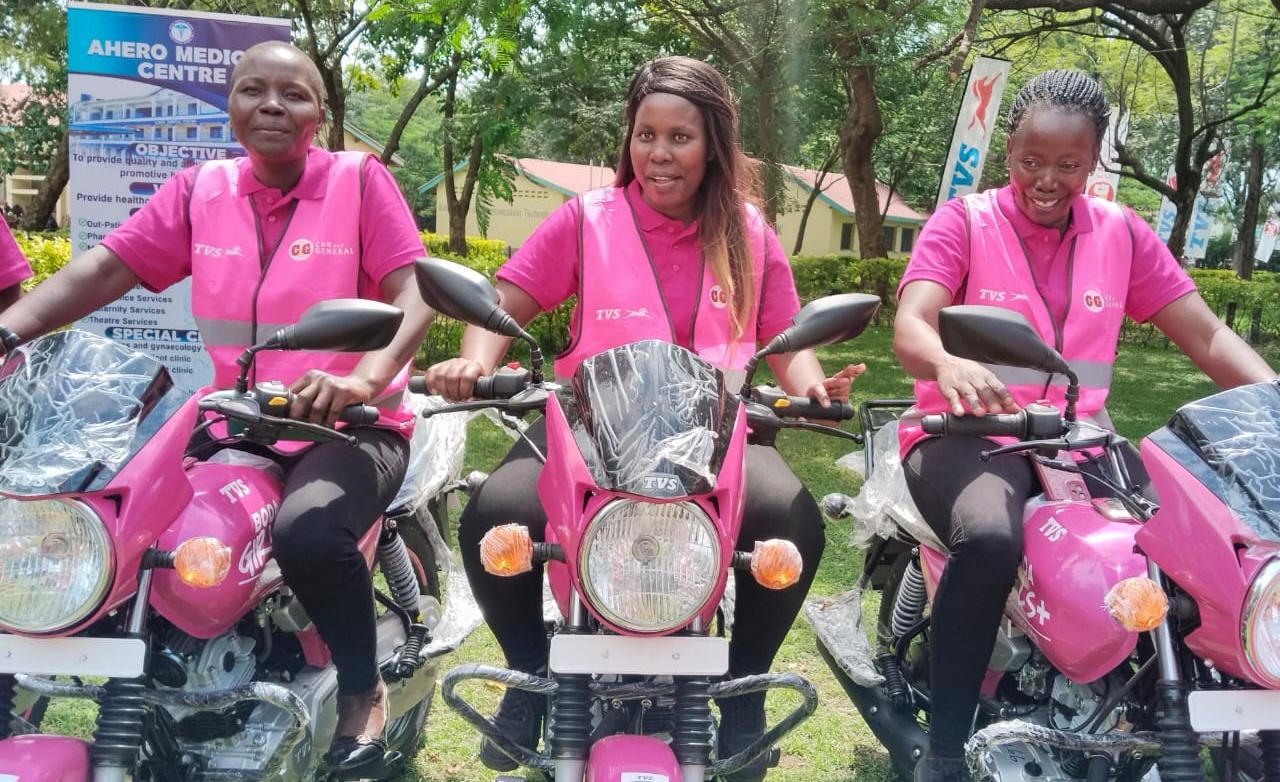
The mother of two is among a growing number of female motorcycle riders under the Boda Girls Kenya programme, an initiative designed to bridge healthcare gaps in rural communities by providing safe transport for women seeking medical services.
The programme trains women riders to transport expectant mothers and vulnerable patients to hospitals for maternal healthcare, cervical cancer screening, family planning services and gender-based violence support.
“When I was told what Boda Girls do and how they help women who are unable to reach hospitals, I was very delighted,” Adhiambo says.
She rides with a mission larger than business.
“We are trained on how to handle and speak to patients suffering from fistula, cervical cancer and other conditions so that they feel supported and encouraged,” she explains.
In many rural parts of western Kenya, access to healthcare remains a major challenge.
Long distances to hospitals, poor road networks, transport costs and fear of harassment by male boda boda riders often discourage women from seeking medical attention.
According to Unicef estimates, Kenya records more than 5,000 maternal deaths and 35,000 infant deaths annually, with many women in rural areas still delivering at home due to delayed access to health facilities.
Boda Girls Kenya hopes to change this narrative.
The organisation, which operates in Kisumu, Homa Bay and Siaya counties, has built a growing network of women riders offering safe and trusted transport solutions for women in underserved communities.
The initiative recently received a major boost after Car & General, in partnership with TVS, an Indian brand, donated 32 motorcycles during the launch of a new partnership in Ahero. The motorcycles form the first phase of a broader expansion programme expected to reach more counties.
The riders will also receive helmets, protective gear and safety training in line with National Transport and Safety Authority regulations.
Car & General general manager George Rubiri said the partnership is aimed at improving maternal healthcare access and empowering women economically.
“At Car & General, we are committed to making a positive impact in every community we serve. This partnership with Boda Girls Kenya is about more than mobility — it is about dignity, safety and saving lives,” he said.
Rubiri said the company invested more than Sh7 million in the pilot programme, which has shown early positive results.
He said hospital deliveries had doubled in pilot areas where women gained improved access to transport.
“We believe we have a mandate to support the communities where we do business and to ensure we are bringing dignity and supporting livelihoods,” Rubiri added.
Under the programme, women riders receive training not only in motorcycle riding and road safety, but also in maternal health awareness and community mobilisation.
At Chiga St Elizabeth Hospital, Adhiambo Julie says the initiative is already transforming lives even before full rollout of the motorcycles.
The facility helps transport five to six patients every week through referrals coordinated with community health volunteers (CHVs).
“We work closely with CHVs who introduce us to the communities and help identify women who need healthcare services,” she says.
Julie says joining Boda Girls Kenya fulfilled a long-held dream of serving her community.
“When I was introduced to Boda Girls, I felt that my dreams had come true because I have always wanted to serve the community,” she says.
Despite resistance in some areas where motorcycle riding is still considered a male occupation, she says attitudes are gradually changing.
“Some people believe women cannot ride boda bodas, but with time this is changing,” she says.
Rider Okoth Moline says the programme is restoring hope among women in rural communities.
She says riders work closely with nurses and CHVs to identify pregnant women and children needing clinic services.
Even before receiving motorcycles, riders had already referred nearly 10 women to health facilities using available transport means.
“With the motorcycles now available, we shall be able to help more women and children access healthcare services,” she says.
Okoth recalls one emergency case that reinforced the importance of the initiative, where she helped a woman in labour reach hospital safely before the programme was formally rolled out.
“This programme will really help the community because transportation costs will be minimised and women will now access free and safe rides,” she says.
Boda Girls Kenya CEO Nancy Akeyo says the initiative was born out of concerns over insecurity and harassment faced by women using male boda boda riders.
“About 98 per cent of boda boda riders are men and women are not always safe. Boda Girls was created to address that challenge,” she says.
According to Akeyo, the organisation trains women not only as riders but also as health advocates and entrepreneurs within their communities.
The programme currently operates in Kisumu, Siaya and Homa Bay, with expansion plans to Migori by the end of the year.
The organisation is targeting 43 hospitals in 14 counties within five years, while aiming to support at least 800 women riders and serve more than one million people annually.
“At the moment we have 60 active Boda Girls riders and we expect to have 160 by the end of the year,” she says.
Akeyo says a pilot involving 20 riders recorded a 67 per cent increase in hospital deliveries and a doubling of maternal and child health clinic visits.
Beyond free healthcare transport, riders are also allowed to take private clients to improve their income and financial independence.
At Ahero Medical Centre, the impact is already visible. Facility director Ojowi Morris says transport barriers and fear of harassment by male riders have long kept women away from hospitals.
“Now that we have Boda Girls, women will feel safer and more comfortable accessing services,” he says.
To support the programme, the facility will pay Sh500 for every successful maternal referral resulting in delivery at the hospital and Sh100 for every general patient referral.
Ojowi says the initiative complements government efforts to improve maternal and child healthcare services.
For Cynthia Adhiambo, however, the work is more than transport or statistics. Every ride is personal. Every woman she transports reminds her of the mother she lost — and of the many others who can still be saved if help reaches them on time.