


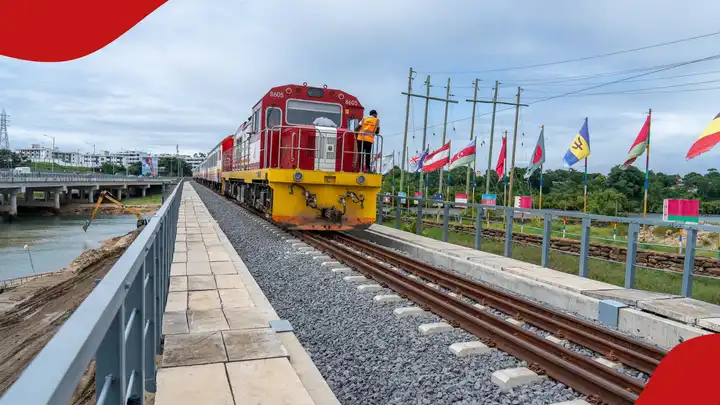
Due to a technical evaluation study and a predicted cost savings of $772.7 million (KSh 99.7 billion), President William Ruto’s administration has opted for a southern corridor railway for the Standard Gauge Railway (SGR) extension to Kisumu, abandoning alternate routes via Nakuru or Eldoret. The government will extend the SGR along the southern route. Photo: Kenya Railways. Source: Facebook The approved plan favours the Nairobi-Naivasha-Kisumu-Malaba route, which will pass through the counties of Narok, Bomet, Kericho, Nyamira and Kisumu. Why did Ruto’s government abandon the Nakuru/Eldoret route? According to Daily Nation, planners cited engineering viability, cost effectiveness, economic potential, and long-term regional development considerations as important factors in their decision to reject the Nairobi-Nakuru (northern route) and the Nairobi-Nakuru-Kisumu-Malaba (middle route).
“Three broad route corridors were comparatively evaluated based on engineering feasibility, environmental, cost implications, social considerations, and alignment strategies with national development strategies,” the study stated. According to information in the Environmental and Social Impact Assessment study, the southern route makes greater financial sense in terms of economic hubs, engineering geology, and investment requirements, even though its running costs are comparable to those of the central route. The route requires about $772.7 million less investment and only passes through 133 kilometres of high seismic intensity zones, which is 80 kilometres less than the Rift Valley fault-affected areas in the northern alternative. The government wants to enhance rail transport. Photo: Kenya Railways. Source: Facebook Its limitation is that, despite connecting important towns like Narok and Kisumu, its economic hubs are somewhat smaller than those along the middle route.
Which Kenyan towns will benefit from the SGR extension plan? As the state works to construct a 263.7-kilometre SGR from Naivasha to Kisumu and create commercial and logistical hubs along the route, several quiet rural towns in the Rift Valley and western Kenya are expected to get an economic boost. Under the supervision of Kenya Railways Corporation (KRC), the proposed SGR Phase 2B project will cross five counties, creating a transportation corridor that has the potential to completely transform trade, industrial activity, and urban growth. Starting at the Nairobi-Naivasha SGR terminal, the line will travel through Narok, Bomet, Sotik, Kericho, Sondu, and Ahero towns before coming to an end in Kisumu city. It will then be extended to Malaba. “When completed, it will ease the constraints caused by the existing transport system,” the blueprint added. Why did Kenya secure new terms for Chinese SGR loans? To ease the hefty quarterly payments, Kenya extended the terms of the three Chinese loans used to construct the first phase of SGR until 2040. The Treasury revealed that it negotiated updated terms. The extension, which is estimated to have saved the country an estimated $215 million (KSh 27.7 billion) a year, included the conversion of the three dollar-denominated loans into yuan.
Source: TUKO.co.ke