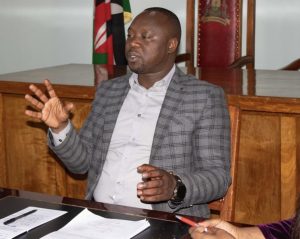



Kiharu Member of Parliament, Ndindi Nyoro, has proposed the creation of a national education kitty to fund free day secondary education nationwide, including meals.
Nyoro said full implementation of the programme would require about Sh30 billion annually, an amount he argued can be raised by consolidating existing education funds and adding support from the national government.
Under the proposal, Sh20 billion would be pooled from existing devolved funds, with Sh10 billion drawn from the National Government Constituencies Development Fund (NG-CDF) and another Sh10 billion contributed by county governments through deductions from their equitable share.
The remaining Sh10 billion would be injected by the national government through budget adjustments within the Ministry of Education.
The legislator said the plan draws inspiration from the Masomo Bora Programme, recently launched in Kiharu constituency, which subsidises secondary education by requiring parents to pay only Sh500 per term for tuition and meals.
“What we did in Kiharu on launching a programme where learners pay Sh500 per term is the journey towards totally free basic education in Kenya, and we’re going to make it happen,” Nyoro said.
The proposal comes at a time when most parents are struggling to enrol their children on Grade 10, prompting the government to instruct school principals to admit them without fees.
The government said it would utilise available bursary funds to assist affected families to ensure children don’t miss the critical final phase of their basic education.
Speaking at a public forum in Mombasa on Thursday, Nyoro described the Masomo Bora initiative as a practical step towards guaranteeing every Kenyan child access to education, which he said is critical to the country’s future.
While encouraging other constituencies to learn from the Kiharu model, he cautioned against relying on constituency-based programmes, warning that they could widen inequalities if implemented unevenly across the country.
“Instead of me doing this programme in Kiharu and another one doing it in their constituency, my proposal is simple, and we will do it. I will be the champion of the programme, and it will be done,” he said.
Nyoro outlined a straightforward formula for financing the national kitty, saying each constituency would contribute Sh30 million, translating to a total of Sh10 billion nationally.
County governments would collectively add another Sh10 billion, while the national government would provide the final Sh10 billion.
“Kenya requires only Sh30 billion to make day secondary school education totally free, including lunch,” he said.
He said the push for free secondary education is long overdue and should begin immediately, calling for urgency in the implementation of the initiative.
“My call is to have free basic education from term two of 2026,” Nyoro said, adding that a national education kitty would end the practice of politicians using education support as a campaign tool during election periods.
Nyoro linked free and quality education to long-term economic growth, arguing that education is a key driver of development.
“Because in all economic models, education is the number one parameter for the economy to grow,” he said.
The former chair of the National Assembly Budget and Appropriations Committee said Kenya has sufficient resources but struggles with effective management.
He added that any legal barriers to establishing the proposed kitty could be amended.
“Laws in Kenya are versatile… they are dynamic and therefore they are not cast in stone; you can change,” he said.
On January 2, the Ministry of Education announced it had disbursed Sh4.4 billion in capitation to public primary and secondary schools ahead of the 2026 academic year.
If such funds were aligned with Nyoro’s model, the remaining annual funding gap would stand at about Sh5.6 billion, after factoring in contributions from NG-CDF and county governments.
by EMMANUEL WANJALA