


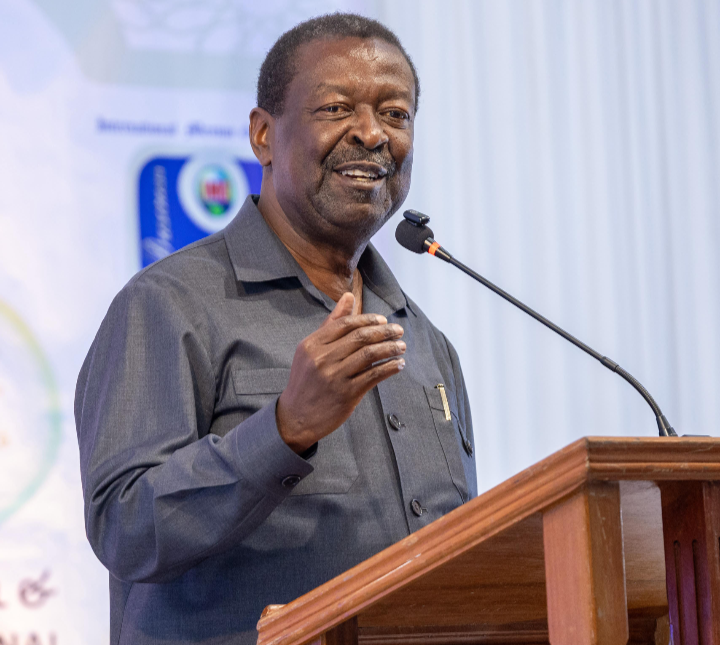
Prime Cabinet Secretary Musalia Mudavadi has called on Kenyans to embrace President William Ruto’s “Singapore development model”.
He said it offers a clear blueprint for transforming the country into a high-income and globally competitive economy.
Mudavadi said the government is developing policies and long-term plans anchored on principles that helped shape Singapore’s rapid rise into a modern, efficient state.
“We have to work towards it; we have to get in together and pull in ideas. We have to dream, and then figure out how to make those dreams a reality. To do that, we have to plan,” he said.
He was speaking on Saturday during the launch of Vision 100 of the International Memon Organization (IMO) East Africa chapter.
Mudavadi said the ongoing national debate on whether Kenya can emulate Singapore is healthy, especially as the country moves deeper into the Kenya Kwanza administration’s third year.
The IMO is a global non-profit promoting resilience, self-empowerment, collaboration and community uplift through education, health, business and humanitarian initiatives.
He urged Kenyans not to dismiss the idea simply because it appears ambitious.
“Kenyans are throwing jokes and saying what’s all this about, we will never become like Singapore,” he said.
“But if there are people here thinking of Vision 100 and you have benchmarked on history that in 1830 there was someone who had a vision, then it is clear if Kenyans can conceptualise the Vision 100, then it is possible you can have a Singapore target and surpass that target.”
Mudavadi recalled that during his time as Finance Minister, the government had sought technical cooperation with Singapore to modernise the port of Mombasa due to the country’s globally recognised efficiency.
He said early efforts to partner with the Port of Singapore were blocked by local resistance.
“Believe you me, the people who are criticising the concept today actually existed even at that time,” he said.
“We were supposed to sign an MOU, so that the Kenyan port of Mombasa could work with the port of Singapore on modernisation, improvement and efficiency.”
He added that Kenya’s development is often held back by internal resistance rather than lack of opportunity.
“Believe it or not, Kenyans chased away the Singaporeans. It is now about 30 years ago. Here we are again, over 30 years later, still saying you don’t want to work and benchmark with better standards,” he said, praising the IMO for embracing broader global vision.
“I am glad I am addressing a community that has a different alternative that is talking about Vision 100, a vision beyond Singapore.”
Mudavadi warned that Kenya cannot progress if it remains inward-looking.
“Kenya will not grow if we continue as an inward-looking people. We must get ourselves to see the examples, the developments and the best practices that are taking place in other countries,” he said.
Economic experts argue that achieving such a trajectory requires consistent fiscal discipline, stronger national savings, borrowing strictly for long-term infrastructure, a functional national infrastructure fund, and zero tolerance for corruption.
They also emphasise the need for predictable rule of law, efficient governance, improved ease of doing business and long-term economic planning beyond five-year political cycles.
by SHARON MWENDE