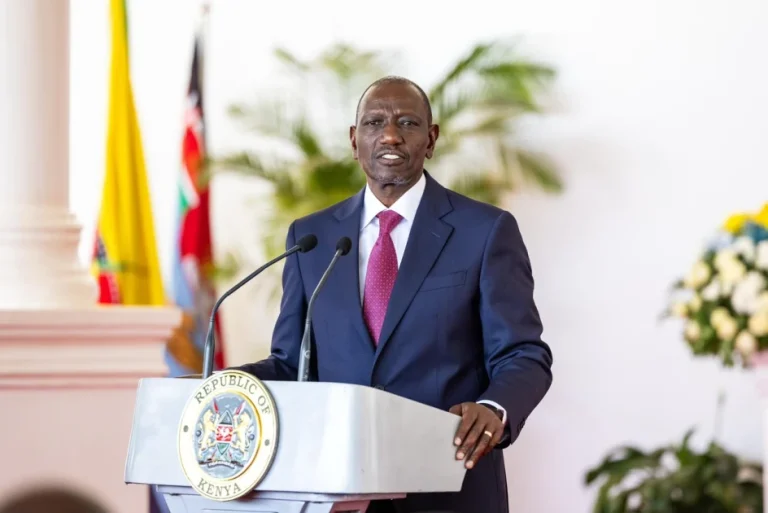
In October this year, President William Ruto approached former Baringo Senator Gideon Moi, who was preparing to return his nomination papers for the then-vacant Senate seat.
Moi, the KANU chairman, had been nominated by his party as he sought to regain a seat he lost to the late William Cheptumo in 2022.
However, Ruto had other ideas. He could not allow the scion of Kenya’s second President, Daniel arap Moi, to engage his UDA party in an open contest. The President was aware of political undertones in Moi’s Baringo backyard.
In the end, emissaries, including the late former Prime Minister Raila Odinga, Lands PS Nixon Korir and Kapseret MP Oscar Sudi were dispatched to talk to their “friend”, a move that appeared to work when Gideon failed to show up in Kabarnet to return his papers.
This was followed by a meeting of Baringo elders at State House, Nairobi, before Ruto headed to Kabarak on October 10, the following day, to address KANU members who were disgruntled by Moi’s absence.
Politics and quiet negotiations
The events that culminated in Gideon Moi dropping out of the by-election once again raise the issue of President Ruto turning to the so-called “Dynasties” for political support less than three years after an election battle framed as “Hustler vs Dynasty”, a phrase coined by none other than Ruto himself.
“The president (William Ruto) knows why I never made it to the ballot. I had some unfinished business in Baringo, from roads to dams; that’s why I decided to vie. Because President Ruto was elected by Kenyans, I decided to listen to him,” Gideon Moi said.
President Ruto added, “Attended a KANU grassroots meeting, Kabarak, Nakuru County, where the party agreed to work with Kenya Kwanza under the broad-based government. Glad that KANU, under the leadership of Chairman Gideon Moi, will work with us to address the challenges facing our country.”
Gideon’s elder brother Raymond Moi also lost his Rongai parliamentary seat to the UDA wave in 2012, while his nephew Clint Moi is said to be eyeing the Eldama Ravine parliamentary seat.
Narrative and the dynasties debate
While serving as Deputy President, Ruto often complained that dynasties—describing sons and daughters of Kenya’s political establishment—were united in seeking to stop him from ascending to power.
The message resonated strongly with his support base, especially given that his then boss, President Uhuru Kenyatta, had backed his erstwhile rival-turned-ally Raila Odinga of ODM. Uhuru’s late father, Jomo Kenyatta, was Kenya’s first President, while Raila’s late father, Jaramogi Oginga Odinga, was the country’s first Vice President.
Gideon Moi had also thrown his weight behind Raila, as well as Musalia Mudavadi and Moses Wetangula. The latter two ditched Raila at the last minute to join Ruto and eventually won the Presidency.
Following the truce, there has been speculation that either Gideon or one of his nominees will be appointed to the Cabinet in the much-anticipated executive reshuffle.
Ruto’s victory in 2022 may have shattered the myth that political dynasties are dispensable. However, post-election developments are reinforcing the notion that powerful men and women whose parents once dominated the political scene are here to stay.
Legacy and political families
Take the case of Raila Odinga’s death on October 15, 2025, in India. Though long buried, he remains influential even in death, with his Kango ka Jaramogi gravesite almost turning into a pilgrimage site.
The day after his death, ODM held an emergency National Executive Committee (NEC) meeting and appointed Siaya Senator and his elder brother, Dr Oburu Oginga, as the new party boss.
Makadara MP George Aladwa justified the move, saying, “ODM belonged to Raila Odinga. We have to get an Odinga to replace Baba. If it’s not Dr Oburu, then it should have been Mama Ida Odinga. If not possible, Raila Jr or Winnie Odinga or even a grandchild of Raila. We have to have an Odinga in that position.”
The Odinga family remains one of the country’s most influential dynasties. Raila succeeded in inheriting his father’s opposition base and served with him in Parliament, having been elected Lang’ata MP in 1992.
After Jaramogi’s death in 1994, Dr Oburu replaced him as Bondo MP, continuing a political journey that began before independence. Their sister Ruth Odinga is Kisumu Woman Representative, while Raila’s daughter Winnie represents ODM at the East African Legislative Assembly (EALA).
Winnie has publicly questioned Oburu’s appointment, arguing that the party should have convened a National Delegates Convention.
Another sister, Wenwa Akinyi Odinga, is a respected diplomat and academic, while Akinyi Walkowa Odinga, who earned her PhD from Durban University of Technology in 2025, serves as deputy consul-general in Los Angeles.
On the Kenyatta side, the family that produced two Presidents—Jomo and Uhuru—also remains politically relevant. Uhuru has met Ruto several times, including hosting him in Gatundu and later at State House.
The Kenyatta lineage, alongside the Kibaki and Wetangula families, underscores how dynastic threads continue to weave through Kenya’s political court.
by GEOFFREY MOSOKU