


For many urban households, the morning routine was once simple: put on the kettle, brew tea and pour in fresh milk.
Today, that familiar ritual has become a frustrating daily scavenger hunt, with shoppers moving from one supermarket to another in search of a packet.
“I have been looking for milk for the past two weeks. Yes, you will be told of a place with milk, but when you delay, you find empty shelves,” says Cyndy, a shopper in Nairobi.
She says when she tries to buy milk at the bigger supermarkets, she often finds only brands selling at around Sh135 a packet, a price she considers difficult to justify.
“How can milk be that expensive? It’s not like it’s lactose-free,” she asks. Buying milk from shops in residential estates is another option, although Cyndy says customers are often limited to two or three packets.
“When you visit the shops near the house, you will find some brands of milk that we are not used to seeing, but the issue is that they are sold at Sh80 a packet. How can that be?” she says.
Frustrated by the difficulty of finding milk at a price she considers reasonable, Cyndy says households may have to rethink their morning drinks.
“At this rate, we do not have to drink milk. I think we have the option of strong tea or even porridge,” she says as she walks away.
Cyndy’s experience reflects the frustrations of shoppers facing dwindling supplies, rationing and prices that vary considerably from one outlet to another.
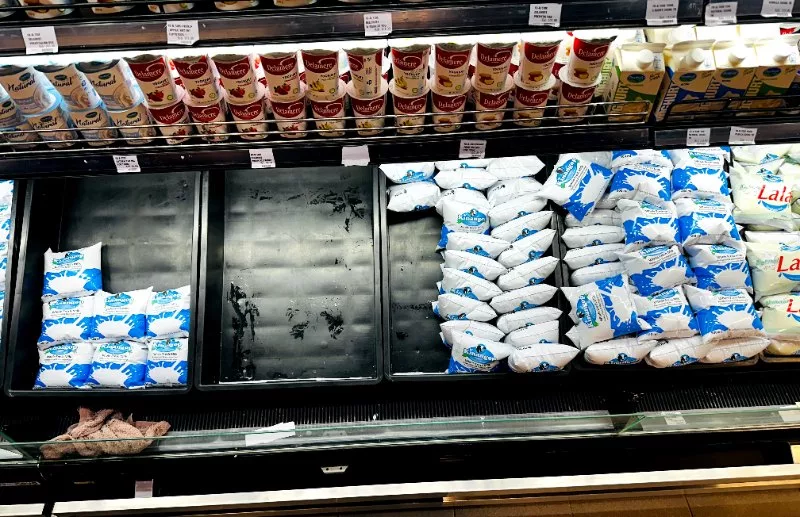
A spot check by the Star across Nairobi found empty shelves and limited stocks, with supermarket staff advising customers to arrive early if they hoped to find fresh milk.
At Carrefour inside Sarit Centre, the refrigerated dairy section stood bare before mid-morning. “If you want packeted fresh milk, arriving after 10 am is a wasted trip,” a store attendant warned as he wiped the empty shelf.
The section had fermented milk and yoghurt, but no fresh milk packets.
One shopper pointed out that another section previously used to stock milk had been replaced with eggs.
“In fact, the other side where they put milk has now been stocked with eggs,” the shopper said.
The shortage was not confined to Carrefour.
Further down the road, at Naivas inside The Mall, a single brand offered a brief glimmer of hope, only for the remaining packets to disappear into shoppers’ baskets within seconds.
“Milk is gold nowadays,” one shopper said while placing one of the remaining packets in her basket.
At Quickmart Westlands, the search yielded nothing, with staff advising customers to arrive early in the morning. “You need to be here by 6:00 am,” one employee said.
The shortage also appears to extend beyond supermarket shelves. Milk ATMs at the locations visited were idle, while raw milk, where available, cost more than Sh90 per litre.
Reports from Nairobi, Kisumu and Nakuru point to a wider supply squeeze, with some retailers limiting the number of packets customers can buy.
In some shops, signs restricting purchases to three packets per customer have become part of the shopping experience.
Behind the shortages is a decline in the amount of milk reaching formal processors.
Kenya Dairy Board data shows that formal milk intake fell from 84.4 million litres to about 81.3 million litres in July 2026.
The comparison period, however, needs to be established to determine the precise scale of the decline.
Agriculture Cabinet Secretary Mutahi Kagwe has attributed the shortfall to dry spells that have depleted pastures and driven up the cost of animal feed, leaving farmers struggling to maintain production.
Kagwe said milk deliveries to processors had dropped by 5.8 per cent, ruling out foot-and-mouth disease as the cause of the shortage.
“There is a 5.8 per cent drop in milk arriving at processors,” he said. “Drought means cattle aren’t fed as well as they should be.”
The Consumers Federation of Kenya (COFEK), however, has criticised the government’s handling of the crisis, describing the shortage as a foreseeable and largely avoidable policy failure.
The consumer lobby says commercial animal feed costs have risen by nearly 45 per cent, putting additional pressure on smallholder farmers, who account for about 80 per cent of the country’s milk supply.
It has faulted authorities for failing to maintain strategic milk powder reserves or absorb previous surpluses, and called for duty waivers on feed inputs, including soya and yellow maize, to ease production costs.
The pressure on farmers has also affected how milk reaches consumers.
With production costs rising, some farmers are bypassing cooperatives and selling directly to brokers or neighbourhood customers who can offer immediate cash payments, potentially reducing the volumes available to formal processors.
Kagwe acknowledged that the shortage had encouraged consumers to seek milk directly from farms, adding to the pressure on processors.
“When people hear there is no milk, they go straight to the farm, which starves formal processors,” he said. Meanwhile, fears of further shortages are changing shopping habits.
Households that would ordinarily buy one packet are purchasing several at a time, adding to the rush to secure supplies before shelves are emptied.
The government maintains that the shortage is seasonal and expects improved rainfall to regenerate pastures and help normalise milk production.
“When the rains come, this whole thing disappears,” Kagwe said. For Cyndy and other households struggling to find milk at a price they can afford, however, the promise of rain offers little immediate relief.
Until supplies improve and prices become more predictable, the simple act of buying a packet of milk may continue to mean visiting several shops, spending more than expected or rethinking what goes into the morning cup of tea.