


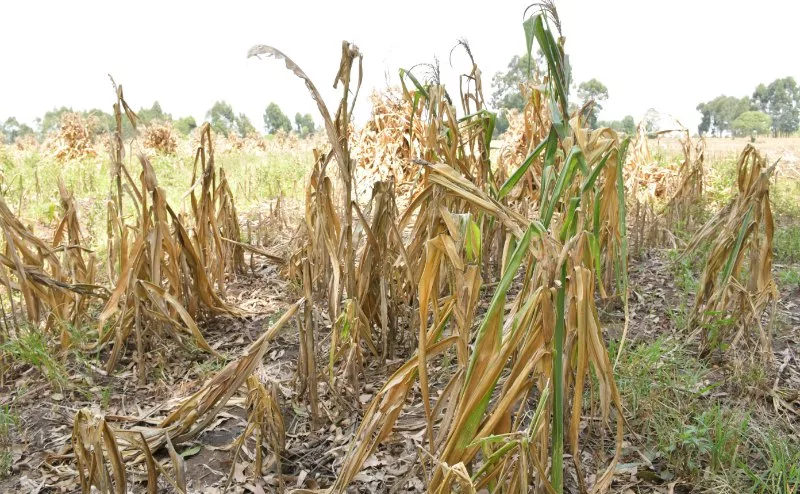
Poor maize harvests in Kitale, Trans Nzoia county, are being felt beyond the farms.
As maize supplies decrease, grain prices are rising, putting additional pressure on livestock farmers who depend on maize and other grains to feed their animals.
For Trans Nzoia dairy farmer John Kimani, feed has become the biggest hurdle in his 20 years of dairy farming.
He says farmers travel long distances to look for fodder and other feed, adding to their production and transport costs.
At his farm, the impact is already visible in the amount of milk produced.
Kimani says his herd of 23 cows now produce between 400 and 460 litres of milk a day, down from about 700 litres previously.
“The milk is decreasing because of the cost of food. The current failed maize crop in the region goes far beyond the grain market. For us dairy farmers, maize is an important source of energy in feed rations, while maize by-products are also widely used by feed manufacturers,” he says.
When maize becomes scarce and expensive, farmers face higher feed bills at a time pasture and other fodder are also under pressure from inadequate rainfall.
James Mwangi, the Association of Kenya Feed Manufacturers (Akefema) Mt Kenya region chairperson, says the shortage is creating pressure across the livestock value chain.
Inadequate raw materials have increased the cost of commercial feed, putting dairy, poultry, pig and beef farmers under greater financial pressure.
“About 70 per cent of manufactured animal feed are made from grains. So when grain prices go up, the cost of feed also goes up,” Mwangi says.
The problem is not limited to maize. Kenya relies heavily on imported feed ingredients, particularly protein sources.
At the 2026 African Feed Conference and Exhibition, Akefema chairperson Joseph Karuri said more than 80 per cent of critical feed ingredients, including soybean, sunflower meal and cottonseed meal, are imported.
Raw materials account for about 70 to 80 per cent of feed manufacturing costs. This means shortages or price increases in either local grains or imported ingredients can quickly feed into the price farmers pay for commercial feed.
Kenya also has a large structural feed deficit. The livestock development department estimates the country requires about 55 million tonnes of dry matter feed annually but produces only 40 per cent of this requirement, leaving a deficit of 33 million tonnes.
The government’s National Feed Strategy is intended to address the shortage and reduce the cost of livestock production. In July, the government announced plans for a Sh465 billion strategy aimed at improving feed availability, affordability and quality. For farmers such as Kimani, however, the immediate concern is keeping cows productive.
Mwangi says Kenya needs to reduce its dependence on a few sources of feed raw materials and expand production of alternative grains and protein crops.
“We need to diversify our sources of animal-feed raw materials and develop another grain basket, including through irrigation,” he says.
Mwangi says relying heavily on the Rift Valley as the country’s main grain-producing zone leaves the feed industry vulnerable whenever the region experiences drought or crop failure.
The current crisis comes at a time when Kenya’s dairy sector is experiencing pressure on milk supplies.
According to the Kenya National Bureau of Statistics, marketed milk increased by 11.6 per cent to 1.014 billion litres in 2025, showing the importance of a reliable feed supply to the growing dairy industry.
More recently, milk deliveries to processors have fallen. Formal deliveries declined from 84.4 million litres in June 2026 to 81.3 million litres in July, with preliminary indications pointing to continued supply constraints in August.
Dr Martin Murigi, director of the Kenya Agricultural and Livestock Research Organisation’s Biotechnology Research Institute, says the feed challenge is increasingly linked to changing weather patterns.
He says farmers in the North Rift have experienced significant crop failure as weather patterns become less predictable, making it necessary to invest in crops that can withstand water stress and mature faster.
“The changing climate is making it increasingly important for farmers to have access to crops that can withstand water stress and mature within shorter periods,” Murigi says.
He points out Kalro’s drought-tolerant maize varieties, including Ukamez, which can mature in about three-and-a-half to four-and-a-half months, giving farmers an opportunity to harvest before available soil moisture is depleted.
But Murigi says climate change is also altering the pest and disease pressures farmers face, including the spread of pests such as fall armyworm and changing weed pressure associated with shifting rainfall patterns.
He says feed security cannot be separated from crop production.
Murigi says a failed maize crop reduces the grain available for food and feed, while inadequate rainfall also reduces pasture and fodder.
Farmers are then forced to buy more expensive commercial feed, cut the amount of feed given to animals or travel further in search of fodder, and in some cases, reduced nutrition means lower milk yields.
Kimani says he is seeing this on his farm. With his 23 cows producing between 400 and 460 litres a day, compared with about 700 litres previously, the drop in production is directly affecting his income.
The Ministry of Agriculture’s 2026 National Agriculture Sector Investment Plan notes that feeds account for more than 70 per cent of the total cost of animal production and puts available feed at about 25 million tonnes against a national requirement of 55 million tonnes of dry matter.
This leaves farmers such as Kimani exposed whenever drought hits the country’s main grain-producing areas, and as the maize fields of Trans Nzoia struggle, the effects are therefore being felt in dairy sheds far beyond the crop itself.