

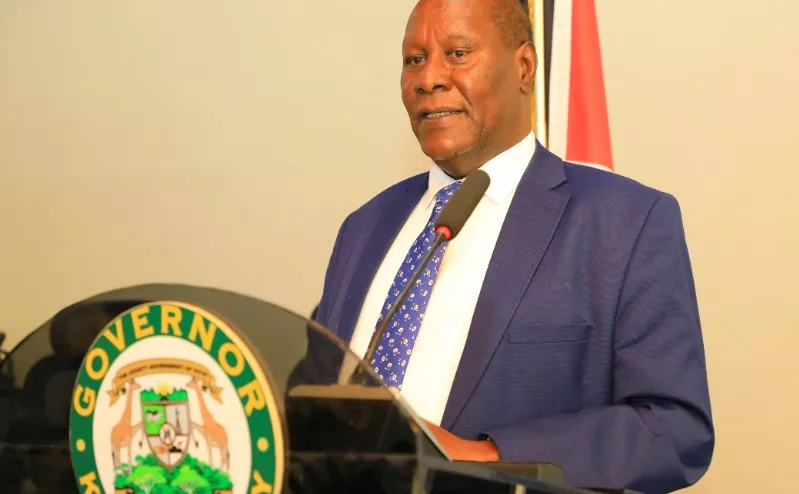
The race to succeed Kitui Governor Julius Malombe is shaping up to be one of the county’s most consequential political contests, as competing ambitions expose early fault lines.
Who gets the Wiper nomination is a riveting issue.
At the centre of the contest is a crowded field that includes Senator Enoch Wambua, Kitui Central MP Makali Mulu, Woman Representative Irene Kasalu and former Governor Charity Ngilu.
Others who have declared interest are corporate executive Nicholas Mulila, former Deputy Governor Peninnah Malonza and political activist Musili Kauta.
The most immediate question is not simply who will win the governorship; it is whether the candidates can navigate the political alliances, party nominations, grassroots networks and competing claims to leadership that are likely to determine the outcome.
Wambua has so far moved furthest into the open.
The Wiper Patriotic Front senator formally launched his campaign on August 10 at Kitui Stadium, unveiling a 12-month countywide mobilisation programme.
His early entry places him in the unusual position of having publicly claimed the political space while some of his strongest potential rivals remain in the consultation and networking phase.
However, his decision to launch early also carries a political risk.
At least two other Wiper hopefuls—Kasalu and Mulu—are also positioning themselves for the seat.
Neither has formally launched a governor campaign, but both have been active at the grassroots level.
Wambua’s warning against unnamed aspirants allegedly misleading voters by claiming they have already secured the Wiper ticket underlines the significance of the nomination battle.
For a field containing several candidates seeking the same party platform, securing the ticket could prove almost as important as the eventual countywide campaign.
Mulu brings a different proposition. After three terms as Kitui Central MP, he is banking on a development record that supporters credit with projects in roads, water, education and bursaries.
His growing tours across the county suggest an attempt to convert that constituency-level record into a countywide political brand.
Kasalu, meanwhile, is pursuing a quieter grassroots strategy. Her empowerment programmes, consultations and distribution of bursaries and other support are helping her establish networks away from the political spotlight.
The presence of Ngilu makes the race even more unpredictable. Having served as governor from 2017 to 2022, she is seeking a comeback under the “Restore and Rebuild Kitui” banner.
Her campaign is built around the argument the county lost its development momentum after her departure.
Her experience and established political networks could give her a formidable base, particularly if the contest becomes a referendum on the county’s development trajectory.
Mulila represents a different political proposition. The Safaricom executive is building his profile through consultations with community leaders and support for local development initiatives rather than large rallies.
Malonza could introduce another dimension if she secures the UDA ticket. Her association with President William Ruto gives her a potential national political platform, while her previous role as deputy governor provides county-level experience.
Kauta, meanwhile, is pitching generational change, positioning himself as a younger alternative to established political figures.
The emerging contest therefore presents voters with competing claims: experience against generational change, established political networks against grassroots mobilisation and development records against promises of a new political direction.
For Wiper, however, the biggest challenge may be managing its own succession contest. If Wambua, Mulu and Kasalu all remain in the race, the party faces the delicate task of choosing a candidate without alienating supporters of those who lose the nomination.
With the election still months away, Wambua may have opened the race, but he has not necessarily settled its direction.
His rivals are using the quieter phase to build networks, test their support and position themselves for the battles that will follow.
The real contest in Kitui may therefore begin long before the ballot—first within parties, then across competing political networks and finally among voters.
Kitui’s political contest is also unfolding against the backdrop of an economy largely driven by agriculture, livestock, small businesses and trade.
The county’s farmers depend heavily on drought-resistant crops such as green grams, sorghum and pigeon peas, while livestock keeping remains an important source of income in many rural areas.
Mining, particularly of limestone and other minerals, also offers economic potential. Water access, roads, markets and irrigation are therefore likely to feature strongly in the candidates’ campaigns as voters weigh which leader can expand economic opportunities and improve household incomes.
For many voters, however, the governor race will ultimately be judged against everyday economic realities.
Traders want better markets and roads, farmers need reliable water and access to buyers, while young people are looking for jobs and business opportunities.
The next governor will also inherit the challenge of attracting investment while making county services more effective.
These economic concerns could prove just as important as party loyalty and political alliances when Kitui voters make their choice in 2027.