

For Lokai Meshack, farming in Turkana is not easy due to water scarcity. The temperatures are also high and much of the land is sandy. But the Nanyee irrigation scheme has brought hope to Lokai and other farmers because now they can grow crops even in such difficult conditions.
Lokai, a lead farmer at the scheme, has about one-and-a-half acres under cultivation. He is among 110 farmers working on a demonstration plot where improved cowpea varieties are being tested and farmers trained on better farming practices.
The demonstration plot, which was started with the help of the Kenya Agricultural and Livestock Research Organisation, has given farmers an opportunity to try different varieties and see what performs best in their own fields.
“Through the demonstration, we were able to learn about different cowpea varieties, including KATEX 7 and KATEX 14, as well as local cowpea varieties. These varieties generate good yields and bring us income. Through farming, we are able to get food, generate income, and take our children to school,” Lokai says.
The farmers use water from a canal to irrigate their crops, but access to water remains one of their biggest challenges.
Lokai says they would like to have more land and reliable water so they can increase production.
He also wants Kalro to have a permanent presence in the area so that farmers can continue receiving advice on improved farming practices. “Having Kalro close to farmers would help us a lot,” he says.
The demonstration plots are part of the Food Systems Resilience project, which is supporting Kalro to introduce improved crop varieties and technologies to farmers in Turkana.
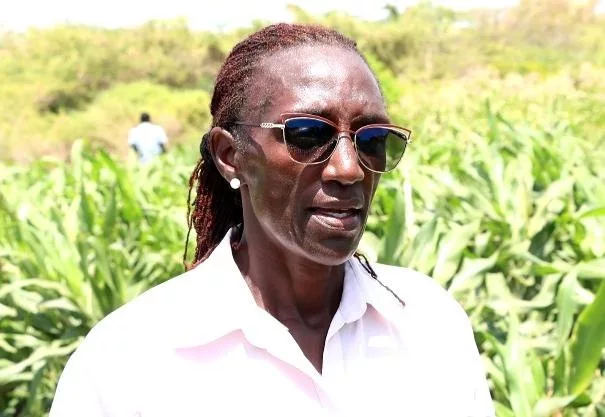
Rose Kuruma, a cowpea breeder at Kalro‘s Katumani station, says the project has established demonstration sites in four wards in the county. They include Nanyee and Napool irrigation schemes in Loima subcounty, as well as sites in Turkwel and Kanamkemer wards.
At the sites, farmers are growing 10 improved cowpea varieties and taking part in the management of the plots. Farmers are being allowed to observe the crops and decide which ones they prefer.
She said some of the varieties mature in about 60 days, while others take up to 90 days. Farmers have been involved in planting, weeding and other crop management activities.
Two varieties, KATEX 7 and KATEX 14, have so far attracted the farmers’ attention because of their early maturity and good yield performance.
The farmers were also given some older commercial varieties to compare. Interestingly, they did not select the older varieties.
Wangari says this is important because farmers are the ones who ultimately decide what they will plant.
“When farmers are given an opportunity to observe the performance of different varieties in their own fields, they are able to make informed decisions and select what works best for them,” she says.
She says that in Turkana, where food insecurity remains a major concern, cowpea could play an important role because of its ability to withstand dry conditions.
Wangari says cowpea is a drought-tolerant crop and is therefore suitable for areas such as Turkana.
“It is also nutritious. The grain contains about 30 per cent protein and important micronutrients including zinc and iron, while the leaves provide vitamins.
“The crop can also give farmers more than one source of income,” she says, adding that the improved varieties being demonstrated are dual-purpose.
Farmers can harvest the vegetables after a few weeks and sell them, or allow the crop to mature and sell the grain.
Some of the improved varieties can produce between 1.5 and two tonnes per hectare.
This makes cowpea attractive to farmers who need both food for their families and crops that can bring in cash.
She adds the intervention is also changing some of the ways farmers grow their crops.
“Before the project, some farmers would buy cowpea grain from the market and plant it as seed. They also often broadcast the seed rather than following recommended planting methods,” Wangari says.
Farmers are now being trained on the importance of using quality seed and following recommended agronomic practices. They are also learning how to manage water more carefully.
At the demonstration plot, farmers are using furrow irrigation instead of simply allowing water to flood the basins.
The breeder says too much water can cause waterlogging and reduce the amount of oxygen available to plant roots. The farmers are therefore being taught to apply water slowly and in a controlled manner.
James Lowoi, the agricultural officer in Loima subcounty, says the emphasis is on allowing farmers to learn by doing.
At the demonstration farms, cowpeas are also being intercropped with sorghum.
The trials, he says, are helping farmers and agricultural officers assess which varieties perform well under Turkana’s conditions and how the crops can contribute to both food production and livestock feed.
Through biological nitrogen fixation, they can contribute to soil fertility and benefit crops planted afterwards. Farmers are being encouraged to use practices such as intercropping and crop rotation.
Florida Ereng, the scheme’s chairlady, says farmers have also learnt better land preparation and crop management since Kalro began working with them.
She says water management remains a challenge. The canal has no proper intake and at times there is no water flowing through it. Water can accumulate and become polluted, while poor drainage can also affect crops.
Ereng says more land and better water infrastructure would allow farmers to increase production and earn more money.
“If we could be given more land for farming, it would really help us because we would be able to increase our production. When we produce more, we can sell our produce and earn money to support our families,” she says.
The demonstration field has also become a place where farmers meet, work together and share what they have learnt with others.
He says young people from the surrounding communities are being encouraged to join farmer groups and take up farming.
“We are here not only to benefit ourselves but also to help other farmers. We want to share what we have learnt with others,” Lokai says.