

The first time I tried to buy a fridge magnet in Beijing, I failed completely at speaking, not because I did not know what I wanted, but because none of the words I had were useful in that small souvenir shop.
I was standing in front of a small painted tile that said ‘Beijing’ in neat characters, pointing at it while an elderly woman watched me from behind the counter, and when I asked, “How much?” she answered in rapid Mandarin that I could not follow at all.
I said it again, slower this time, as if slowing down my English would somehow translate it into Mandarin, and she answered again just as fast, which left us staring at each other for a full minute with nothing but confusion and goodwill between us.
So I did what you do when words fail completely, I started using my hands, picking up the magnet and holding up my phone with a typed “10?” on the screen, and instead of dismissing me, she shook her head, disappeared to the back of the shop, and returned with a fistful of banknotes from different currencies that she laid on the counter one by one, patiently teaching me money without a single shared word when she said, “This one ten bob. Ten yuan. This one… one hundred yuan.”
I thought that was a one-time thing, an exception born out of a tourist shop, but it was not, because that same dance of gestures would repeat itself everywhere I went in the city.
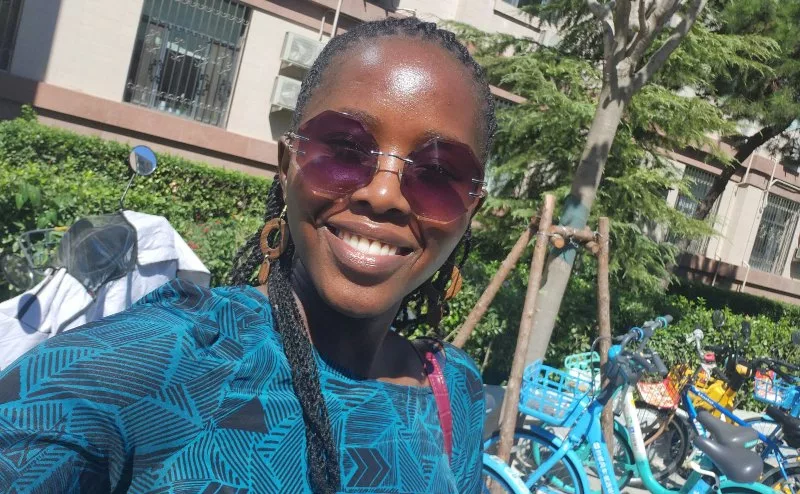
Radio Africa Group deputy digital editor Nancy Agutu in Beijing, China /NANCY AGUTU
A few days later, my colleague needed a shave, so we walked into a small neighborhood barbershop and the room went quiet, not in a rude or hostile way, but in that open astonishment that comes when people encounter someone they rarely see in their own neighborhood, because we were black people in a part of Beijing that probably does not see many black people at all.
Again, there was no English and no Mandarin that we could share, so again we resorted to hands and phones, showing pictures, pointing at our heads and then at our chins to indicate exactly where to shave and where to leave the hair alone, shaping the haircut in the air.
“Hii ni ngumu aki,” my colleague muttered as he waited for them to understand his language, yet to our astonishment we finally came to an agreement, and they cut his hair slowly and carefully, exactly how we had shown them, with such concentration that one of the younger barbers became so excited by the whole encounter that he asked to take pictures with us, and we let him because it did not feel like mocking but like genuine, unguarded curiosity.
That was when I started to understand that in Beijing, politeness is not measured by what people say, but by how hard they are willing to try to help you when you cannot say anything at all, because the gesture itself becomes the language.
And once you see it, you cannot unsee it, because it is everywhere.
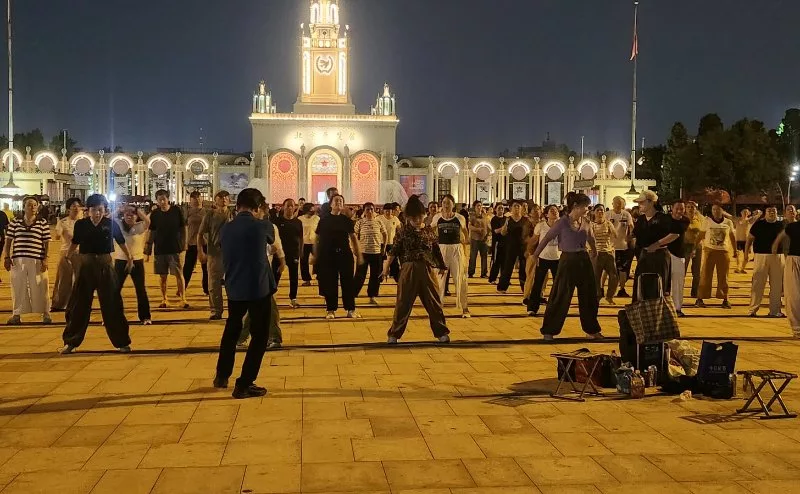
Residents of Beijing, China /NANCY AGUTU
NIGHT OWLS
Beijing does not just gesture when it has to, it lives by gesture, and that became clear on our first night when, jet-lagged and expecting a Nairobi-style nightlife with a packed CBD, loud music, and everyone rushing somewhere, we found the malls already closed by around 8pm and the streets unexpectedly quiet.
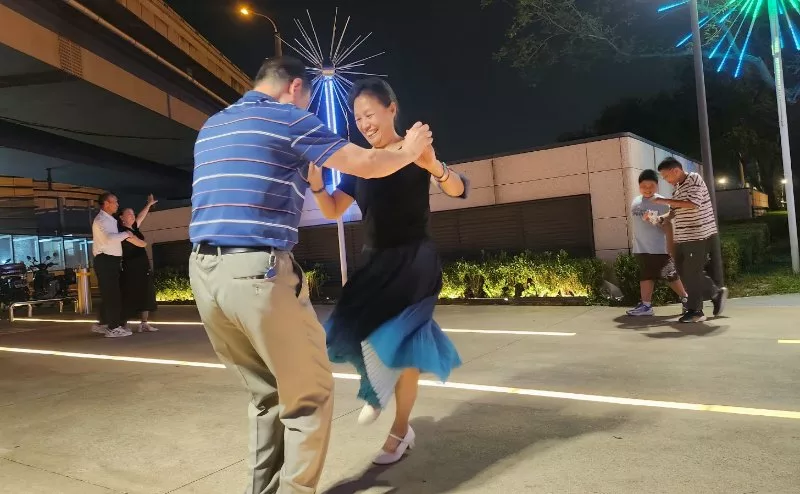
So my friend Lizzy and I decided to walk with no real destination, logging nearly 8,000 steps into the night until we heard music coming from a park called JK Fun, which turned out not to be a club at all but a small portable speaker placed on the ground with a circle of elderly men and women dancing around it in a simple, practiced rhythm of right, right, left, right, left.
Some danced while others sat nearby tapping their feet, strangers who had gathered after a long day not to drink or shout, but to dance away the anxiety of the day together, and a man waved us in with his hands, speaking happily in Mandarin and clearly excited to see us join.
We tried, nearly falling over each other in the process, and they laughed with us rather than at us, and just when we thought we should head back to the hotel because the jet lag was setting in, louder music pulled us to the other side of the park where more than fifty young people had their hands up, then forward, then to the hip, dancing together under the streetlights.
“Let’s go and see and even join them,” I told Lizzy as she smiled and asked if I was sure about that, and we joined again for what felt like a street disco, completely out of step but completely happy in a way that did not require being good at it.
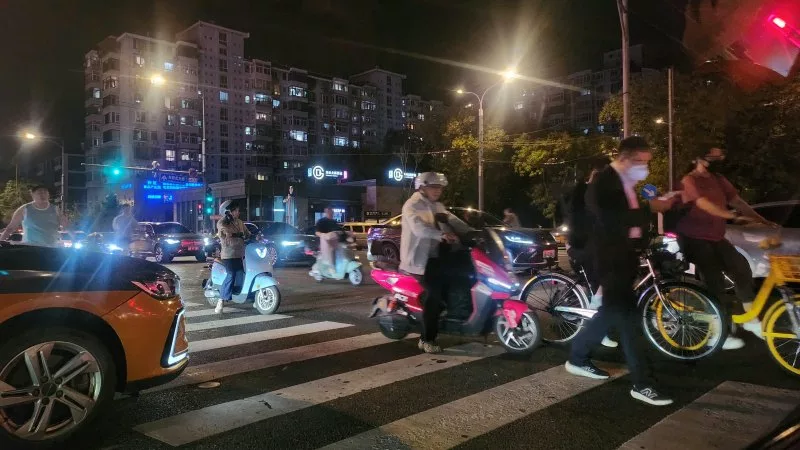
Motorbike riders in Beijing, China /NANCY AGUTU
“This was a good idea,” Lizzy said as she swayed her hands to the tune that was playing, and in that moment, I realised that no one had actually spoken to us and no one had needed to, because the invitation had been a hand extended toward us.
That same unspoken invitation is what you get during the day, and after fifteen minutes of dancing our own uncoordinated things, we decided to call it a night because the jet lag was finally kicking in and we needed rest.
THE HEALTHY NATION
You cannot understand Beijing’s health until you understand its bicycles, those yellow, mint, and black rows that line every street, waiting for someone to scan a QR code and ride, whether office workers, students or delivery riders, all gathered as a silent crowd of cyclists at every red light.
“If it is red, it is red. If it is green, it is green,” I wrote in my notes, because in Nairobi we negotiate traffic while in Beijing they obey it, and that quiet obedience is perhaps why a city of 20 million can still feel surprisingly calm.
And they are always moving, always in motion, which is why they are healthy, not because of an expensive gym membership, but because movement is woven into the very lifestyle of the city itself.
Lunch tells you everything, because while in Kenya lunch is one hurried hour where you eat quickly and return to your desk, in Beijing lunch is two full hours, from 11:30 a.m. to 2 p.m., during which the entire city seems to exhale.
At first I thought it was inefficient, almost wasteful, but then I fell in love with it, because within those two hours you not only eat but also take a walk, and when you walk, you finally see the real Beijing that hides behind the office towers.
I would walk after lunch and find men and women seated on low stools along the streets, playing Chinese chess on boards that were nothing like the black-and-white chess I knew, with wooden pieces etched with Chinese characters and divided into red versus black, hunched over in utter concentration while small crowds gathered to watch, nodding and debating the next move with no one in a hurry to be anywhere else.
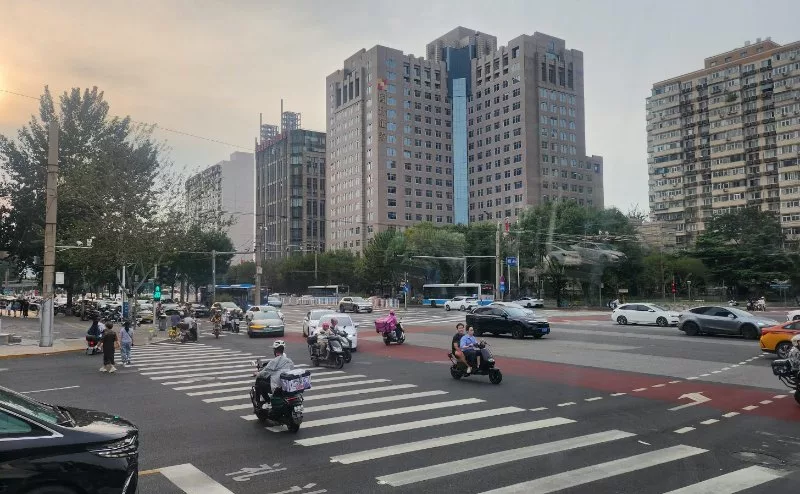
Streets of Beijing, China /NANCY AGUTU
On another afternoon, just outside an office building, I found a group of youth, perhaps thirty-five to forty years old, playing a kind of ball game during their break, not in a stadium or a proper court, but right there on the pavement beside their office, with their shirtsleeves rolled up, laughing and shouting as if they were not waiting for the weekend to live, but were determined to live inside the workday itself.
What I came to understand is that Chinese people love movement, not as exercise as punishment or obligation, but as joy and connection, as a way to shake off the stiffness of sitting and the weight of the day.
The magnet seller, the barber, the dancers in the park, the chess players, the cyclists, it was all the same conversation unfolding in different corners of the city, a conversation that never needed words in the first place.
You just need to be willing to move.