



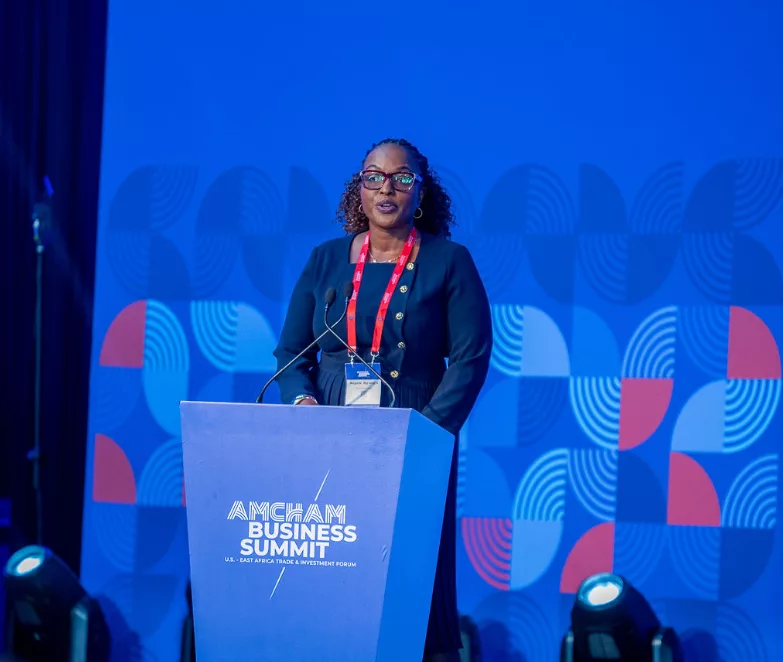
KENYA could attract up to $600 million (about Sh77.5 billion) in fresh investments from American companies over the next year, as US firms deepen their interest in the country as a gateway to the East African market.
The investment pledges were announced during the just-concluded AmCham Business Summit 2026 in Nairobi, where American companies unveiled projects spanning manufacturing, technology, data centres, healthcare, digital skills and other strategic sectors.
AmCham Kenya board president Angela Ng’ang’a said more than $600 million in pledges and commitments had been announced in just one day, with the investments expected to take place over the next year or so.
“We did see just in one day over $600 million of pledges and commitments from US-American firms,” Ng’ang’a said.
Among the biggest announcements was a fresh $175 million (Sh22.6 billion) investment by Coca-Cola in Kenya, adding to the US beverage giant’s existing footprint in the country.
Mars Wrigley also inaugurated a $103 million (Sh13.3 billion) production line, strengthening Kenya’s position as a manufacturing and regional supply-chain base.
The technology sector emerged as another major beneficiary, with Oracle selecting Kenya for its first public cloud region in Africa in partnership with African Data Centres.
The move is expected to expand local cloud infrastructure and strengthen Kenya’s position as a regional digital hub.
iColo ((now Digital Realty) also announced an $80 million data centre project in Nairobi, adding to growing investment in the country’s digital infrastructure.
Healthcare is another area where the summit produced new commitments.
SC Johnson has also announced plans to launch a new factory in Kenya capable of producing up to two million malaria-related units daily.
Pfizer, meanwhile, plans to introduce 15 new pharmaceutical products in Kenya, including cancer treatments.
The announcements come as Kenya seeks to shift its economic relationship with the United States from one centred on development assistance towards trade, investment and job creation.
Ng’ang’a said the two countries were looking at a more reciprocal relationship measured through trade volumes, investments and employment.
The summit was also held against the backdrop of the extension of the African Growth and Opportunity Act (AGOA) to December 31, 2028.
The extension maintains duty-free access to the US market for eligible Kenyan exports and provides additional certainty for manufacturers, particularly the apparel industry.
Trade and Investment Cabinet Secretary Lee Kinyanjui said Kenya-US trade in goods and services reached $3.4 billion (Sh439.3 billion) in 2025, with the balance of trade reaching equilibrium.
He said the relationship had expanded beyond traditional trade to include technology, critical minerals, healthcare and development finance.
Kinyanjui cited Kenya’s apparel sector as a key area of the relationship, noting that apparel accounts for roughly 70 per cent of Kenya’s exports to the US, almost entirely under AGOA preferences.
The government is also seeking to use the current investment momentum to attract capital into seven priority areas of agriculture, digital economy, energy and infrastructure, manufacturing, health, critical minerals and the creative economy.
Kenya announced $2.9 billion across 20 investment deals earlier this year during the Kenya International Investment Conference, while previous AmCham summits had generated more than $2 billion in tracked investment commitments.
President William Ruto said investors were increasingly comparing jurisdictions and moving capital quickly when conditions were favourable.
“Capital goes where there is opportunity, but it stays where there is confidence,” Ruto said, underlining the importance of improving Kenya’s investment climate.
He said the government had implemented more than 50 business-enabling interventions covering finance, taxation, business regulation, county licensing and special economic zone laws.
The challenge now is to convert the latest announcements into actual factories, infrastructure, jobs and exports.
During the closing of the summit, Prime Cabinet Secretary and Foreign Affairs Cabinet Secretary Musalia Mudavadi warned that the focus must move from commitments to implementation.
“Promise what you can deliver and deliver what you promise,” Mudavadi said, urging both government and businesses to honour commitments made at the summit.
He said implementation of commitments and the transition from policy to legislation and activity on the ground would be critical.
The government is also seeking greater value addition from Kenya’s natural resources, particularly critical minerals.
The summit discussions focused on moving beyond extraction towards local processing and manufacturing of minerals such as titanium, graphite and lithium.