

Four years into President William Ruto’s administration, the question of how many jobs have been created remains central to the government’s economic record, with official figures showing rising employment but a heavy concentration of new jobs in the informal sector.
Kenya has added about 3.27 million jobs between 2022 and 2025, according to employment figures, with the majority of the new jobs created in the informal sector.
The figures show that 816,600 jobs were created in 2022, including 702,900 informal-sector jobs and 113,700 modern-sector jobs. The 2022 figure serves mainly as a baseline as Ruto took office in September that year.
In 2023, Kenya created 848,200 jobs, the highest annual figure recorded during the period. Of these, 720,900 were in the informal sector, while 122,800 were in the modern sector.
The economy added 782,300 jobs in 2024, including 703,700 informal-sector jobs and 78,600 modern-sector jobs. Informal employment accounted for about 90 per cent of all new jobs created that year.
In 2025, the economy created 822,100 jobs, according to the KNBS Economic Survey 2026. Of these, 716,800 were in the informal sector, accounting for 87.2 per cent of the total, while about 105,300 were added outside the informal sector.
Overall, about 2.84 million of the 3.27 million jobs created between 2022 and 2025 were in the informal sector, accounting for roughly 87 per cent of the total. Approximately 420,400 were modern or formal-sector jobs.
The latest Kenya National Bureau of Statistics figures show that total recorded employment, excluding small-scale agriculture, increased from 20.8 million in 2024 to 21.6 million in 2025.
The informal sector’s total employment rose to 18.1 million, while wage employment increased from approximately 3.21 million in 2024 to 3.32 million in 2025.
Alongside the wider economy, the government has identified the Affordable Housing Programme as one of its main job-creation initiatives.
In January 2026, Ruto said more than 500,000 Kenyans were working under the housing programme.
“The housing project is about jobs. Today, more than 500,000 Kenyans are working under the housing programme,” he said.
The figure represented an increase from the 200,000 direct jobs Ruto said the programme had generated by December 2024. At the time, the President said thousands more jobs were being created through the wider building and construction value chain.
In February 2026, Housing Principal Secretary Charles Hinga said government data showed that more than 428,000 Kenyans were directly employed full-time at construction sites, with an additional one million people engaged in supplying materials and services linked to the projects.
The employment figures came as the government accelerated construction of affordable homes across the country.
Data cited by Hinga showed that 262,913 housing units were under development in 111 constituencies across all 47 counties by February 2026. The programme is designed to deliver 200,000 affordable houses annually.
In January 2025, Ruto said more than 124,000 housing units were under construction, creating employment for more than 250,000 young people.
Ruto’s December 2024 figure referred specifically to direct jobs, while the 2026 figures included people working at construction sites and, separately, people involved in supplying materials and services.
In May 2026, Labour Cabinet Secretary Alfred Mutua said more than 6.2 million jobs and employment opportunities have been created during President Ruto’s tenure.
Speaking during Labour Day celebrations, Mutua attributed the gains to government reforms and development programmes across various sectors.
He said the public service employed about 1.895 million people, while the education sector absorbed more than 128,000 teachers and county governments employed nearly 60,000 workers.
Mutua also cited government programmes, saying the Affordable Housing Programme created 640,442 jobs, while Kazi Mtaani generated 583,868 employment opportunities.
The figure is higher than the employment growth recorded by the Kenya National Bureau of Statistics. According to the Economic Survey 2026, Kenya created 822,100 jobs in 2025, bringing employment growth between 2022 and 2025 to about 3.27 million jobs.
The KNBS figures measure employment growth across the economy, while Mutua’s figure combines employment and employment opportunities attributed to government sectors and programmes.
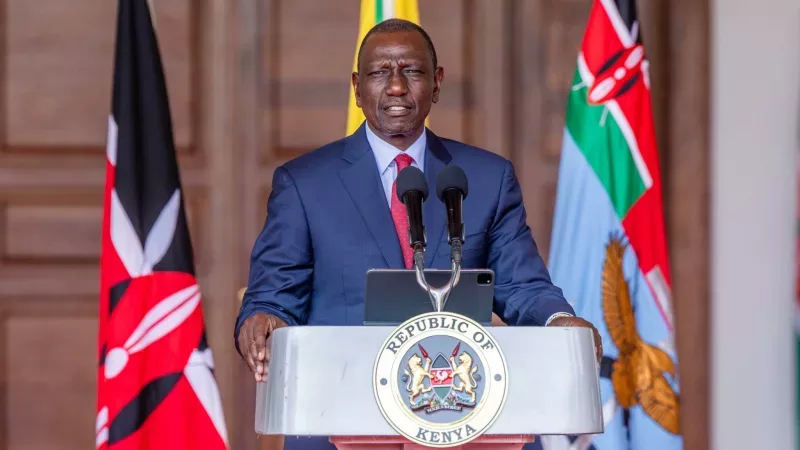
President William Ruto acknowledged that unemployment and lack of income remain major challenges facing Kenya, four years into his administration.
Speaking during the Beyond Vision 2030 national conversation on August 12, Ruto said Kenya still has too many people who are jobless and many others without income, as he outlined areas he believes should shape the country’s long-term development agenda.
The President said addressing unemployment should be part of efforts to tackle inequality and improve the livelihoods of low-income Kenyans.
“How they access employment opportunities. And how we create equality,” Ruto said, while highlighting the need to improve opportunities for people at the lower end of the income scale.
Ruto identified micro, small and medium enterprises (MSMEs) as a major opportunity for expanding employment and incomes.
He said the country must find ways to help MSMEs grow by improving their access to credit, business opportunities and markets.
The President’s remarks come as his administration continues to face scrutiny over its record on job creation, with employment growth dominated by informal work.
According to the latest employment figures cited in the broader Vision 2030 review, Kenya has continued to grapple with a large number of people outside stable employment.
Ruto said the issue should also be considered within Kenya’s next long-term development framework as the country prepares to move beyond Vision 2030.
He said the new framework should take account of changes that have occurred since Vision 2030 was developed, including technological advances, artificial intelligence and the effects of climate change.
The President also said Kenya must focus on reducing inequality, noting that many people still struggle to meet basic needs.
“We have too many people who still sleep hungry. We have too many people who are jobless. We have too many people who don’t have income,” he said.
Ruto said the country’s development plans must therefore address access to employment, education, healthcare and other opportunities for vulnerable Kenyans.
He said that Kenya must confront unemployment as it develops a new long-term vision beyond 2030, calling for a plan that reflects the country’s current economic and social realities.