

Kenya’s journey towards a digitally enabled education has reached a significant milestone, with 363 public primary schools now connected to sustainable Internet.
The plan is under the Last Mile Connectivity of Schools (LCMS) projects.
The announcement by the European Union highlights efforts to bridge the digital divide and ensure rural learners are not left behind.
Despite Kenya’s rapidly expanding digital economy and an estimated 27 million Internet users, access remains uneven. Many rural public schools lack reliable connectivity. The LCMS project aims to address this gap.
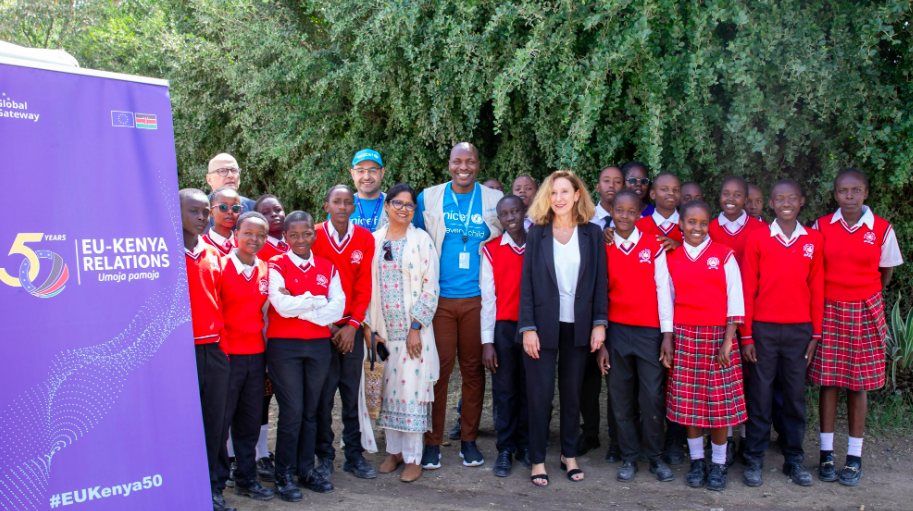
EU Ambassador to Kenya Henriette Geiger visited Enkasiti Primary School in Kajiado county on Tuesday to witness first-hand how connectivity is transforming classrooms.
“Through Global Gateway, the European Union is committed to ensuring digital connectivity reaches the last mile, so no learner is excluded from the opportunities of a modern, digitally enabled education,” she said.
Launched in October 2023, the LCMS project is a cornerstone of the EU’s support for Kenya’s digital transformation.
With a Sh1.48 billion (EUR 9.8 million) contribution, implemented in partnership with UNICEF, the ICT Authority, government ministries and civil society, the initiative aims to connect 1,000 schools across 14 counties.
The goal is to provide learners, including children with disabilities, with access to high-quality digital content, virtual laboratories and online learning platforms aligned with the competency-based curriculum.
As of December 2025, more than 277,000 learners are benefiting from the connected schools, including about 2,800 children with disabilities. More than 4,400 teachers are integrating digital tools into their lessons, with 405 receiving specialised ICT training.
At Enkasiti Primary School, teachers demonstrated how virtual science laboratories and digital content are enriching STEM lessons. Learners also showcased ICT Club projects that highlighted growing creativity and innovation.
EU Deputy director general for International Partnerships Myriam Ferran emphasised the importance of scalable models such as the Client–Hub system. The approach allows centrally connected “hub schools” to extend secure and cost-effective Internet access to neighbouring institutions. It is helping shape national strategies for sustainable school connectivity, particularly in rural and hard-to-reach areas.
UNICEF Kenya Representative Shaheen Nilofer said while progress is encouraging, only 30 per cent of the country’s 23,400 public primary schools currently have Internet access, leaving many children at risk of being left behind.
“Our partnership empowers learners, enhances digital skills and strengthens teacher training in online safety, giving children the opportunity to thrive in an inclusive digital Kenya,” she said.
Looking ahead, the LCMS project plans to connect an additional 637 schools in 2026, continuing efforts to deliver equitable digital education across the country.
by GILBERT KOECH