


Kenya lacks credible geological data to convince investors to put in billions into the mining sector, Kenya Chamber of Mines and Institute of Engineers of Kenya have pointed out.
Despite renewed government’s push on turning mining into a growth pillar of the economy, serious large-scale investors continue to stay away from Kenya’s mining sector.
Industry players now say the reason is not politics, security or even commodity prices — it is the absence of basic, investor-grade geological data needed to justify putting billions of shillings into long-term, high-risk mining projects.
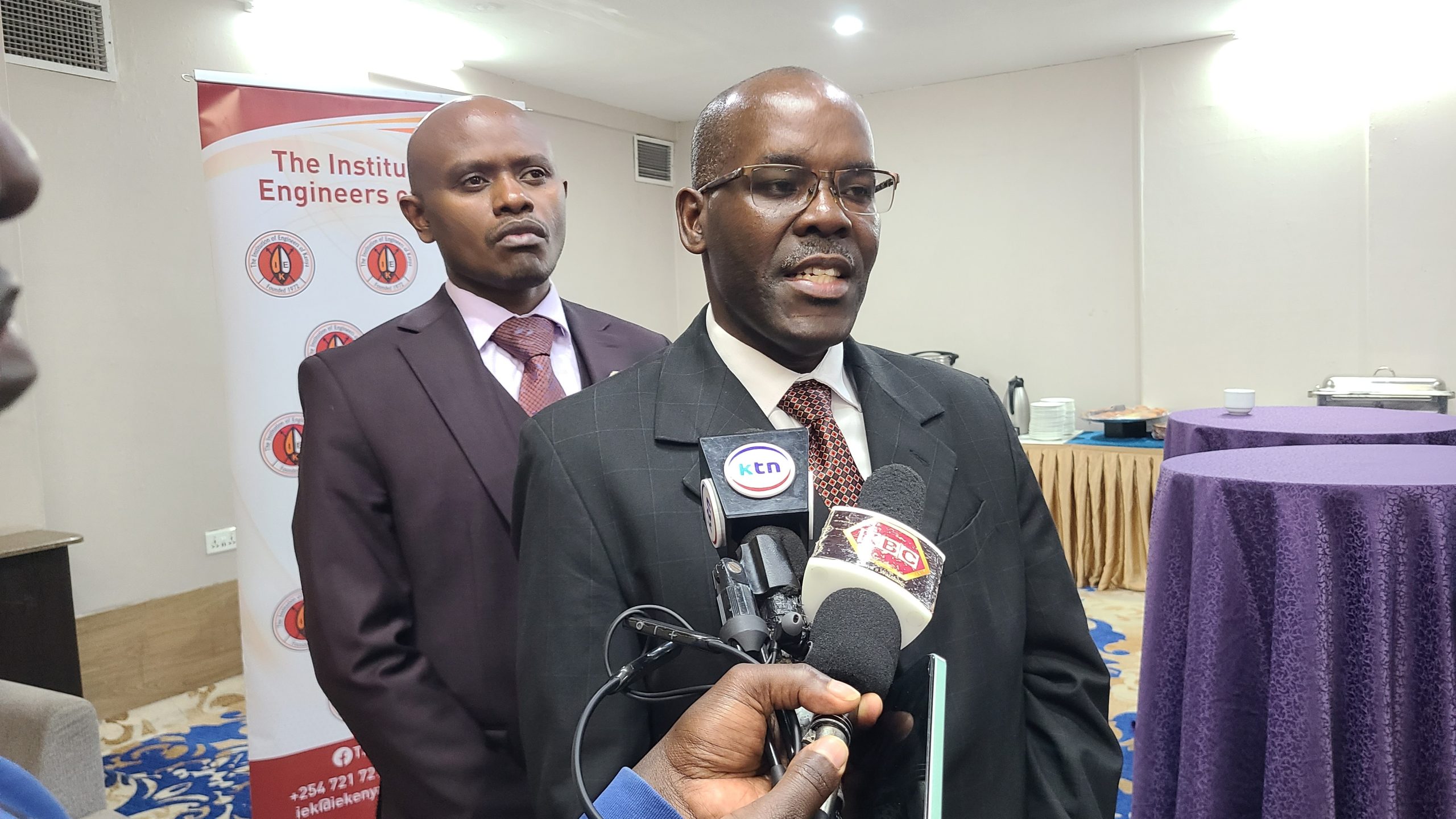
At a mining conference organised by the Institution of Engineers of Kenya (IEK), sector leaders laid bare a structural weakness that have quietly undermined Kenya’s mining ambitions for decades.
While Kenya can confidently say it “has minerals”, it cannot yet prove, in technical, bankable terms how much exists, where exactly it is and whether it can be commercially extracted.
“Investors do not invest on stories or possibilities, they invest on structured, systematic, engineering-backed geological data. That is what Kenya lacks,” said the IEK president Shammah Kiteme.
This gap according to Kiteme, explains why Kenya’s mining sector still contributes about one percent of GDP, far below its potential and well short of the government’s target of growing the sector to three per cent by 2028.
According to the Chamber of mines, Kenya is planning to increase its mining sector contribution to GDP to 10 per cent by 2030.
“Yes, we know minerals exist in places like Mrima Hills, Western Kenya and other regions. But knowing they exist is not enough. Investors want to know grade, volume, depth, extraction costs, environmental risks and timelines. Without that, capital will not come.”
Globally, mining investment is driven by data generated through detailed geological surveys, drilling programs, and feasibility studies that meet international reporting standards.
In countries such as Australia, Canada, and South Africa, governments and private exploration firms have spent decades building comprehensive geological databases that reduce uncertainty for investors.
Kenya, by contrast, is still largely operating at a preliminary discovery stage.
Kenya Chamber of Mines CEO Brian Simiyu, says the consequences of this unavailability of critical data has seen Kenya’s mining industry dominated by artisanal and small-scale miners, many of whom operate informally, with limited capital and high exposure to safety and environmental risks.
This even as large-scale, industrial miners the kind that bring in billions in investment, advanced technology and long-term jobs remain few and far between.
“And yes, we have the mineral resources, but we now need to move to what I would call proven stage. The proven stage is the investor-grade information. The general information for the public is, yes, Kenya has minerals, but investors don’t go with that information,” said Simiyu.
“They want a more structured and systematic view, which is really based on engineering knowledge. And that’s why the engineers have come in handy to say, hey, let us look at mining. We have the resources.”
To address this, industry bodies including the Kenya Chamber of Mines, IEK, and other stakeholders are developing a mining white paper modelled partly on Australia’s experience.
The aim is to propose reforms that prioritise geological data generation, faster permitting, clearer institutional coordination, and investor certainty across the mining value chain from exploration to processing and export.
The white paper, currently under stakeholder consultation, is expected to be ready by the end of the first quarter of the year. Its success, however, will depend on whether recommendations are funded and implemented, not merely published.
“We have engineers who can take projects from exploration all the way to mine production. What we lack is the structured data that allows those engineers to design bankable projects,” added Kiteme.
Kenya’s outdated mining framework has also played a role. For more than seven decades, the sector was governed by the Mining Act of 1940, only replaced in 2016.
While the Mining Act 2016 and the Minerals and Mining Policy of 2016 created a more modern legal foundation, industry players argue that implementation has lagged behind ambition.
Budget constraints have further weakened the state’s ability to close the data gap. In the current financial year, the State Department of Mining received about Sh1.6 billion, of which Sh1.3 billion was earmarked for recurrent expenditure.
by JACKTONE LAWI