


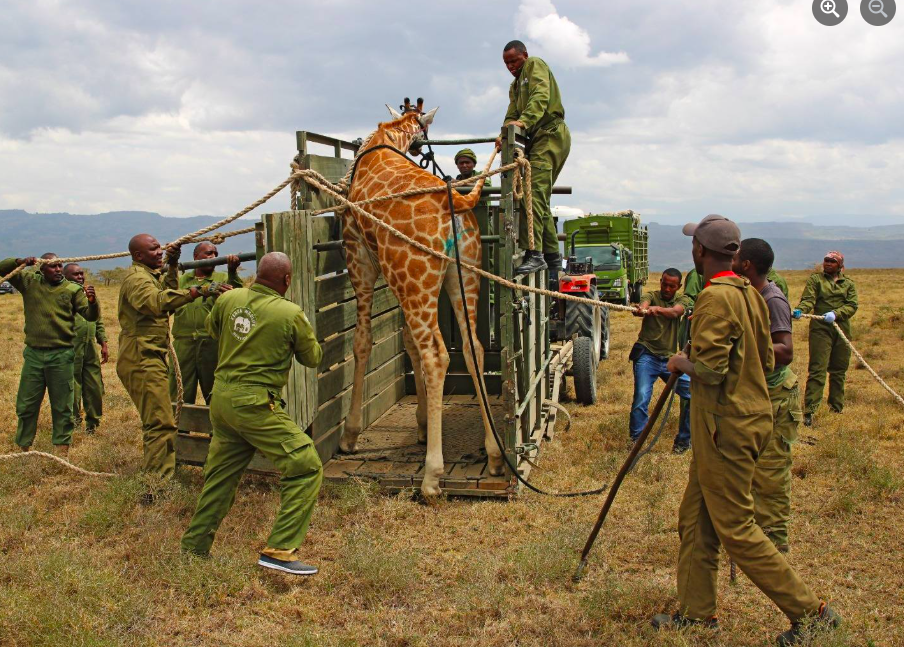
Three young Rothschild’s giraffes have been moved from Soysambu Conservancy to Giraffe Centre in Nairobi as part of efforts to strengthen genetic diversity and prevent inbreeding.
The Kenya Wildlife Service (KWS) said the giraffes, aged two and three years, were relocated to “secure the long-term sustainability of the Nubian giraffe population through continued breeding”.
“This milestone conservation effort, implemented in collaboration with the African Fund for Endangered Wildlife–Giraffe Centre and Soysambu Conservancy, highlights the power of partnerships in safeguarding biodiversity, supporting conservation-based tourism, and strengthening Kenya’s wildlife economy,” KWS said.
In a historic decision on August 21 last year, the International Union for Conservation of Nature (IUCN) officially recognised four giraffe species as genetically distinct. They are Masai giraffe (Giraffa tippelskirchi), Northern (Nubian) giraffe (Giraffa camelopardalis), Reticulated giraffe (Giraffa reticulata) and Southern giraffe (Giraffa giraffa).
In Kenya, the Maasai, Reticulated and Nubian giraffes occupy distinct natural ranges.
Giraffe conservation in Kenya faces multiple challenges, including habitat loss, fragmentation, poaching, human-wildlife conflict, overgrazing and climate change impacts such as drought.
From the late 1970s through the 2010s, giraffe populations declined dramatically, reaching a critical low.
According to the 2025 national wildlife census by the Wildlife Research and Training Institute (WRTI), the total giraffe population rose to 43,002, up 21.63 per cent from 35,355 in 2021.
Historical data shows the population peaked at 77,000–78,000 in the late 1970s, declined steeply to around 30,000 by 2000, and hit a low of 24,000–26,000 by 2012–2015. A gradual recovery has been observed since 2015.
The census indicates Nubian giraffes are on a positive trajectory, with populations increasing from 1,040 in 2021 to 1,388 in 2025—a 33.5 per cent rise—particularly in Ruma National Park and Lake Nakuru National Park.
Reticulated giraffes also recorded a significant increase, growing 51.81 per cent from 20,553 in 2021 to 31,201 in 2025, with Wajir county hosting 41 per cent of the population and more than doubling its numbers.
Meanwhile, the Masai giraffe population declined from 13,762 in 2021 to 10,410 in 2025, reflecting ongoing conservation challenges for the species.
The relocation of the three Rothschild’s giraffes underscores Kenya’s commitment to biodiversity conservation, genetic management and sustainable wildlife tourism.
by GILBERT KOECH