


As organisations increasingly turn to artificial intelligence (AI) to strengthen their cybersecurity, several hurdles continue to slow adoption.
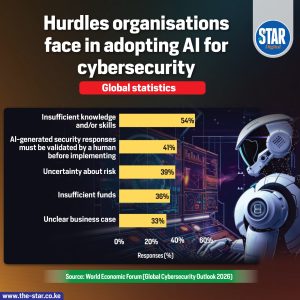
According to the World Economic Forum’s Global Cybersecurity Outlook 2026, more than half of organisations (54%) cite insufficient knowledge or skills as a major barrier.
Many companies lack staff trained in both AI and cybersecurity, making it difficult to implement advanced tools effectively.
Another significant challenge is the need for human oversight. AI-generated security responses must be validated by humans before implementation, a process highlighted by 41% of organisations. This requirement slows response times and reduces the perceived efficiency gains of AI.
Uncertainty about risk also deters adoption. Nearly 39% of organisations remain unsure about potential threats, such as unintended consequences of automated decisions or AI vulnerabilities that could be exploited.
Financial constraints further complicate matters, with 36% reporting insufficient funds to deploy AI-driven solutions. High initial costs, ongoing maintenance, and specialised personnel needs create significant budget pressures.
Finally, a lack of clarity around the business case affects adoption. About one-third of organisations (33%) struggle to define measurable benefits or ROI from AI in cybersecurity, making it harder to secure leadership support or justify investment.
Overall, while AI offers promise in defending against increasingly sophisticated cyber threats, these hurdles—skills gaps, validation requirements, risk uncertainty, limited funding, and unclear business justification—underscore the need for structured strategies, staff training, and clear investment frameworks to unlock AI’s full potential in cybersecurity.
by Rosa Mumanyi