



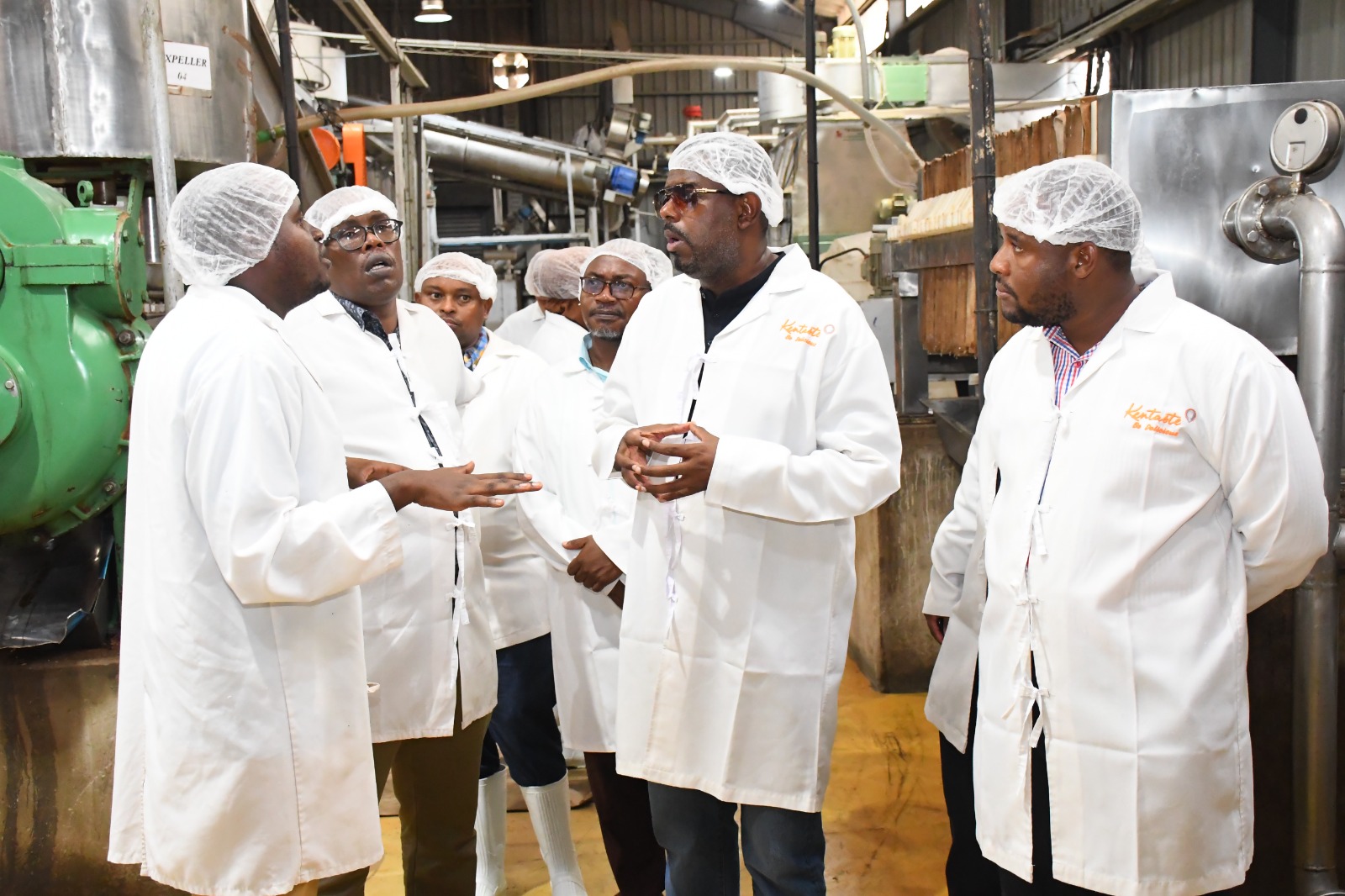
The national government has identified coconut value addition as a key driver for economic growth in the Coast, aiming to expand farmer earnings, open export markets and create industrial jobs for young people.
Investment Promotion PS Abubakar Hassan said the Coast stands to benefit significantly from Kenya’s growing access to regional and international markets if local producers focus on competitive, value-added products.
He spoke during a visit to the Kentaste coconut processing factory in Mvindeni, Kwale county.
The PS said Kenyan manufacturers now enjoy duty-free and quota-free access to markets in East Africa, the wider African continent, the US, the UK, the European Union and China.
Abubakar described coconut as a strategic crop for the region, citing data showing Kenya has more than 100,000 coconut farmers, about 95 per cent of them based at the Coast, and nearly 10 million trees producing an estimated 300 million fruits annually.
Despite this production potential, farmers have long faced low returns due to weak market linkages and limited processing capacity.
He said the Ministry of Investments, Trade and Industry has prioritised the coconut value chain and is working with large processors, including Kentaste, to scale up operations and absorb farmer output.
“We want farmers to be assured of a reliable market. Increased processing will allow value addition, job creation and better incomes,” Abubakar said.
He praised the Kwale government for creating a conducive business environment that has attracted investors, adding that county support is critical for industrial growth.
Abubakar also highlighted incentives offered under the Special Economic Zones Authority and the Export Processing Zones Authority, which provide tax relief and reduced regulatory requirements to lower production costs and improve competitiveness.
He said government teams are sensitising manufacturers to take full advantage of these programmes.
Kentaste chief executive officer Kyle Denning said the company has been operating in the coconut sector for more than a decade, steadily expanding its sourcing and processing capacity.
“We began by sourcing about 5,000 coconuts per day. Today, we source close to 1.5 million coconuts a month from smallholder farmers in Kwale, Lamu and other regions,” he said.
Denning said Kentaste produces a range of products, including virgin coconut oil, coconut milk, cream, chips, water, flour and desiccated coconut, which are sold in supermarkets nationwide. He said the company is expanding into Lamu and Kilifi counties in partnership with county governments.
The factory employs nearly 300 full-time workers in Kwale and supports hundreds more indirectly along the value chain, with upstream activities supporting more than 50,000 livelihoods daily.
Abubakar said value addition activities create multiple employment opportunities and align with the government’s industrialisation agenda, noting that industrial jobs are one of the four pillars of the President’s youth employment strategy.
A representative of the Kwale government said the county is supporting farmers by distributing free hybrid coconut seedlings to replace ageing trees and increase productivity.
Special Economic Zones Authority CEO Kenneth Chelule said the government is accelerating efforts to attract investors, with nine special economic zones planned along the Coast from Kwale to Lamu, alongside several export processing zones.
He said coconut processors such as Kentaste are well-positioned to benefit from these frameworks and compete globally.
by CHARLES MGHENYI