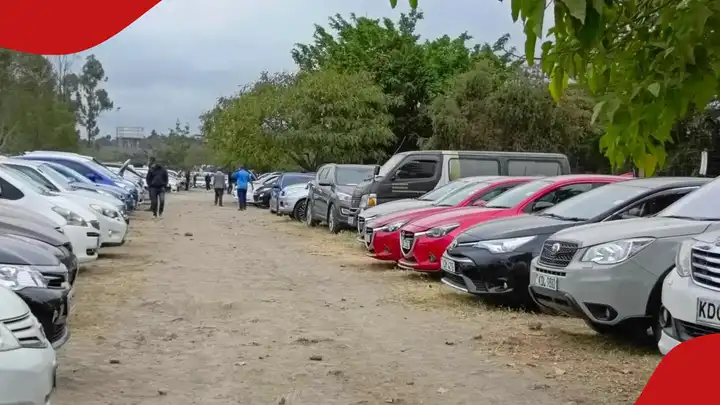



Second-hand car dealers have opposed the government’s plan to gradually reduce the age limit of imported units, with a target to lock out used vehicles from entering Kenya by 2030.
In a newly proposed policy, Kenya targets to cut the age limit of imported used vehicles from the current eight years to five by 2027, a further reduction to three years by 2029, before strictly disallowing second-hand imports (zero) by the year 2030.
Through the Car Importers Association of Kenya (CIAK), dealers in the country have raised an objection to the plan.
Among key issues being raised by the dealers is inability of local assemblers to meet national demand, where plants currently operate significantly below the required capacity to replace the used-vehicle market.
Kenya requires over 100,000 units annually for light vehicles with local assembly currently meeting only 30 per cent of this demand.
This places annual assembly capacity, majority being Completely Knocked Down kits imported and assembled locally, at an average of 30,000 against an installed capacity of about 46,000 units.
The trade is dominated by three main plants—Isuzu East Africa on Mombasa Road, Nairobi (formerly General Motors), Mombasa-based Associated Vehicle Assemblers (AVA) and Kenya Vehicle Manufacturers (KVM) in Thika.
Importers and dealers have also cited monopolistic risk saying forcing a zero-year limit by 2030 creates a “captive market” where a few manufacturers can dictate prices without competition from high-quality used imports, which will push vehicles out of reach of millions of Kenyans.
There is also lack of technological readiness (Euro 4 Standards) in the country which CIAK says is contradictory to enforcing a “New Only” policy on the basis of environmental protection, when local assemblers have yet to fully adopt and prove consistency with Euro 4 emission standards.
Euro 4 emission standards, introduced in 2005-2006, are a set of European regulations that significantly reduced allowable exhaust pollutants—specifically nitrogen oxides.
They forced the adoption of cleaner technologies including better catalytic converters and diesel particulate filters. They were later superseded by the stricter Euro 5 standards in 2009–2011.
“Importing a five-year-old vehicle from a tier-1 market like Japan often results in lower emissions than a “brand new” locally assembled vehicle that may not meet the same global stringent standards,” CIAK national chairman, Peter Otieno, says in a memorandum of objection to the government, through the Director, Standards Development and International Trade Division, Kenya Bureau of Standards.
He says a zero-to-three-year age limit will also double or triple the entry price for vehicle ownership, making units unaffordable in the “hustler” economy and the burgeoning middle class which relies on affordable seven to eight-year-old vehicles for mobility and business logistics.
“Removing this bracket is an attack on the Right to Livelihood (Article 43 of the Constitution). It is also a breach of WTO Principles on Non-Tariff Barriers (NTBs). As a signatory to the World Trade Organization , Kenya must adhere to the General Agreement on Tariffs and Trade (GATT),” said Otieno.
Article XI (GATT) prohibits the use of quantitative restrictions and “other measures” (like arbitrary age limits) that act as disguised barriers to trade.
CIAK says a more legal and effective approach would be mandatory emissions testing which targets the pollution directly, rather than the age of the vehicle.
It has also cited procedural unfairness and lack of consensus in the policy, noting that international standardisation protocols dictate that standards should not be “enforced” onto stakeholders but rather “agreed upon” through a consensus-based approach.
The current proposal also lacks a Regulatory Impact Assessment (RIA) that proves how the economy will survive a projected more than Sh50 billion at the Port of Mombasa, dealers say.
Used vehicles dominate over 85 per cent of Kenya’s road network, with approximately 130,000 units imported annually at a cost of roughly Sh60 billion, with key markets being Japan (80%), UAE, UK, Singapore and South Africa.
“While we support the long-term goal of national industrialisation, the proposed timelines are economically catastrophic, technologically premature and legally inconsistent with Kenya’s obligations under international trade law,” said Otieno.
In December, the government rolled out the Kenya National Automotive Policy as part of plans to revitalise the automotive industry by promoting local assembly and manufacturing.
Trade Cabinet Secretary Lee Kinyanjui said the policy was deliberately tailored to gradually reduce the over reliance on imported used vehicles, with the government extending incentives mainly favourable tax regulations to local assemblers.
“Interventions such as the duty remission scheme that will now regulate importation of some automotive parts such as batteries, radiators and brake fluids will go a long way in boosting local industries,” he said.
CIAK however, further urgues that the policy infringes on Kenyans’ rights among them limiting consumer choice to a narrow, expensive set of locally assembled models and disrupting the value chain of over 500,000 Kenyans (mechanics, dealers, clearing agents).
It recommends that the government suspends the 2027–2030 timelines and maintain the eight-year rule until local production reaches 70 per cent of national demand.
Kenya should also shift focus to emissions by enforcing Euro 4 or 5 standards on all imports regardless of age, focusing on the quality of the engine rather than the year of manufacture, and lower taxes for local assemblers to make their prices naturally more attractive than imports, rather than banning imports to force sales.
by MARTIN MWITA