



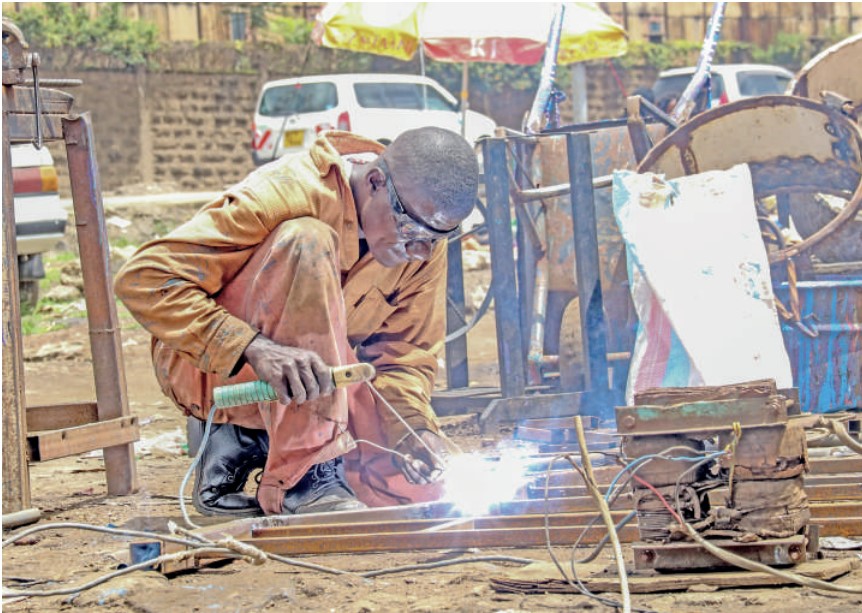
Small businesses, supported by widening access to credit, are emerging as critical pillars of economic resilience across Kenya’s counties, cushioning households against unemployment and uneven regional growth.
Data from the Gross County Product 2025 report show that participation in micro, small, and medium enterprises (MSMEs) plays a decisive role in job creation, particularly in counties with limited formal sector opportunities.
The trend is most pronounced in rural and peri-urban counties, where self-employment often substitutes for salaried work.
By June 2025, licensed digital lenders had disbursed 5.5 million loans worth Sh76.8 billion, increasingly filling financing gaps left by traditional banks, particularly for micro and small enterprises.
The expansion of small businesses has been reinforced by improved access to credit.
Nationally, the share of adults with loans rose to 64 per cent in 2024, up from 60.8 per cent in 2021.
Counties with higher MSME participation generally report stronger credit uptake, enabling traders to restock, farmers to smooth cash flows and informal enterprises to expand operations.
County-level data reveal sharp regional contrasts. Kilifi, Kwale and Kiambu posted some of the highest proportions of adults engaged in small businesses.
Along the Coast, MSMEs are closely tied to agriculture, tourism and trade, while Kiambu benefits from proximity to Nairobi’s consumer markets and logistics networks.
In these areas, small enterprises have become the primary drivers of household incomes and local demand.
Northern counties such as Wajir and Mandera still have low levels of both small business participation and credit access, reflecting insecurity, sparse markets and limited financial infrastructure.
Late last year, the Central Bank of Kenya (CBK) licensed 42 new Digital Credit Providers (DCPs), pushing the total number of approved digital lenders in the country to 195.
The licensing of 27 DCPs in September 2025 and 41 more in June marks CBK’s steady push to formalise a sector that was once dominated by unregulated apps and predatory lenders. For borrowers, it signals more choice but also clearer rules around how digital loans should be offered and recovered.
According to the report, four counties contribute almost 50 per cent to the country’s Gross Domestic Product (GDP), with Nairobi leading at 27.4 per cent between 2020 and 2024.
The contribution by the country’s capital city is followed by Kiambu, Nakuru and Mombasa.
“The results indicate that economic activity remains concentrated in a few counties. For instance, Nairobi city county accounted for the largest share of Gross Value Added (GVA) at 27.4% in 2024, followed by Kiambu (5.5%), Nakuru (5.2%), and Mombasa (4.8%),’’ the report by the Kenya National Bureau of Statistics shows.
“Together, these four counties contributed about 42.9 per cent of the national GVA in 2024. GCP per capita in Nairobi, Mombasa, Nyeri, Embu, and Nakuru counties was higher than the SH309,460 national average.”
According to the report, between 2023 and 2024, the share of the national economy in Murang’a, Bungoma, Embu, Turkana, Siaya, Taita Taveta, Garissa, and Mandera increased.
It notes that some counties experienced slower growth due to climatic variability, infrastructure limitations, and narrow production bases.
Meru’s proportion of the national economy increased from 3.4 per cent in 2023 to 3.5 per cent in 2024, making it Kenya’s richest agricultural county with an 8.1 per cent contribution to the sector.
Between 2023 and 2024, Murang’a and Bungoma’s contributions increased from 1.9 to two per cent apiece, while Uasin Gishu’s increased from 2.5 to 2.6 per cent.
by VICTOR AMADALA