



Local smartphone manufacturer M-Kopa has raised concerns over the absence of clear and predictable tax guidelines governing mobile phone imports and locally assembled devices.
The local assembler is now warning that the gap is exposing Kenyan phone makers to unfair trade practices and threatening recent investments in domestic manufacturing.
M-Kopa Kenya general manager Martin Kingori says lack of harmonised taxation rules has allowed grey market imports to flourish, undermining firms that comply with local tax and duty requirements.
Beginning January 1, 2025, Kenya Revenue Authority (KRA) and Communications Authority announced they had started tracking all imported and locally assembled phones via their IMEI numbers to ensure tax compliance.
However, Kingori holds that there are majority of imported phones in the market that are passing through customs without paying their fair share of taxes.
“About 90 per cent of devices coming into the country do not pay taxes. That is lost revenue for the government, but more importantly, it creates an uneven playing field for local assemblers who are paying all the required duties and levies,” Kingori said.
Kenya imported more than about 2.3 million smartphones from China in 2024, according to official Chinese export data, a sharp increase from roughly 1.3 million units in 2023.
The demand outweighs the local supply with the phone maker (M-Kopa) estimating that about 666,667 devices are produced annually.
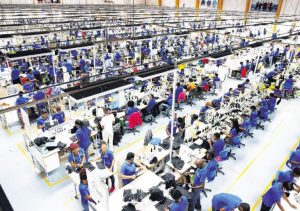
M-Kopa operates a smartphone assembly plant in Nairobi, established in 2023, which has so far produced more than two million devices.
Kingori warned that without firm action against grey market imports and clear guidelines on how phones should be taxed, such investments risk becoming unviable.
“The benefit of local assembly is being diluted. We pay import duty, excise duty and VAT, but devices coming in through informal channels don’t pay any of these. The price gap between locally assembled phones and imported finished products becomes very narrow, making it difficult to compete,” he said.
Over the past three years, the government has introduced several tax measures affecting the mobile phone market, including a 25 per cent import duty in July 2022, followed by an additional levy of about 7.5 per cent, and later an increase in VAT from 16 per cent to 18 per cent in 2023.
While these measures were intended to encourage local value addition, manufacturers say the intended incentives are being eroded by lax enforcement.
M-Kopa says its factory was primarily set up to produce entry-level smartphones for first-time users, a segment that remains significant, with nearly half of its customers using a smartphone for the first time.
Over time, the company has expanded into assembling mid-range and higher-tier devices to cater for customers upgrading their phones.
“We don’t struggle with demand. Our devices match global brands in specifications and quality. The challenge is not the market, it is the unfair competition created by untaxed imports,” Kingori told the Star in an interview.
The company currently serves about 2 million customers in Kenya out of its 4.8 million regional customer base and exports roughly 10 per cent of its locally assembled devices to Uganda, a figure it hopes to grow as regional demand rises.
“We welcome regulation because it ensures everyone plays by the same rules. But some proposals, such as requiring approval for every agent or vendor, could become an operational nightmare if not refined,” he said.
by JACKTONE LAWI