


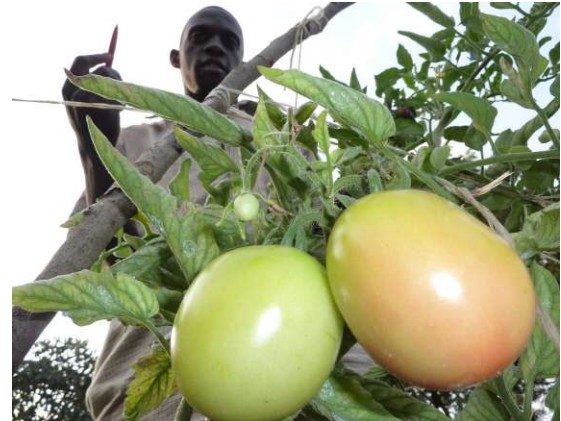
On a warm afternoon in Kajiado county, Mariam Sunte bends over rows of young tomato plants at her farm in Rombo, Loitokitok, carefully inspecting their leaves.
A few years ago, this routine was filled with anxiety.
Pests, diseases and unpredictable weather often meant that no matter how hard she worked, her crops would fail.
“You would plant, invest everything, then watch the crop fail,” she recalls.
Like many small-scale tomato farmers in Kajiado, Sunte relied on open-field farming, a method increasingly vulnerable to the effects of climate change.
But recent training in greenhouse and hydroponic farming has changed the picture.
Sunte is learning to grow tomatoes in controlled environments, a method that reduces losses, improves yields and offers better returns.
“Initially, farmers had many problems with pests and diseases, and even after harvest, losses were high,” she says.
“Now, with hydroponics, we can manage pests, control the environment and produce crops throughout the year. We are expecting better returns.”
Since 2020, Sunte and other farmers have worked closely with researchers and extension officers from the Kenya Agricultural and Livestock Research Organisation (Kalro) and the Korea Programme on International Agriculture (Kopia).
The training focuses on climate-smart technologies and hydroponic systems under greenhouses, enabling farmers to produce high-quality tomatoes with minimal risk from weather fluctuations.
For Shadrack Mwania, another farmer in Rombo, hydroponics also promises to lower costs.
“With local seedling production, farmers will no longer buy seedlings from distant places at Sh7 per seedling. Prices could drop to about Sh5, making tomato farming more affordable,” he says.
County officials are optimistic the shift could transform tomato farming in Kajiado.
Joseph Macharia from the Department of Agriculture explains climate change has pushed production costs up, forcing some farmers to abandon tomato cultivation or recycle seeds.
“Producing tomatoes can cost up to Sh300,000 per season. But hydroponic greenhouse technology and proper training are helping farmers return to production,” he says.
Agricultural extension officers report that Rombo has around 3,000 tomato farmers cultivating about 5,000 acres, producing an average of 50 tonnes per season.
Protected cultivation and hydroponics could double yields to 100 tonnes, thanks to disease-free seedlings and improved crop management.
Dr Ji Gang Kim, director of the Kopia Kenya Centre, highlights South Korea’s success, where more than 90 per cent of tomatoes are grown under greenhouse hydroponic systems.
“Hydroponics helps overcome climatic challenges and ensures high-quality, nutrient-rich tomatoes. Kenya can achieve similar results,” he says, noting that while initial setup costs are high, long-term gains are significant.
Beyond production, hydroponics also stabilises market supply and improves hygiene.
Dr Violet Kirigwa, Kalro’s assistant director of knowledge management, emphasises that hydroponic systems allow year-round production, reducing dependence on unpredictable weather.
“Farmers can supply the market consistently, which helps stabilise prices. There will also be fewer pests and diseases, better hygiene and higher productivity,” she says.
Kalro is addressing seed costs by starting its own breeding programme to release locally adapted tomato varieties, reducing reliance on expensive hybrid seeds from foreign companies.
“For small-scale farmers in Kajiado, hydroponics is no longer just a technology, it is a pathway to resilience and a secure future in tomato farming,” Kirigwa concludes.
For Sunte and her peers, hydroponics has turned anxiety into opportunity.
What was once a gamble with every planting season is now a methodical, profitable venture.
With proper training, locally produced seedlings and climate-smart practices, Kajiado’s tomato farmers are poised not only to meet local demand but also to supply neighbouring counties and potentially export to regional markets, bringing renewed hope to small-scale farmers.
by AGATHA NGOTHO


