


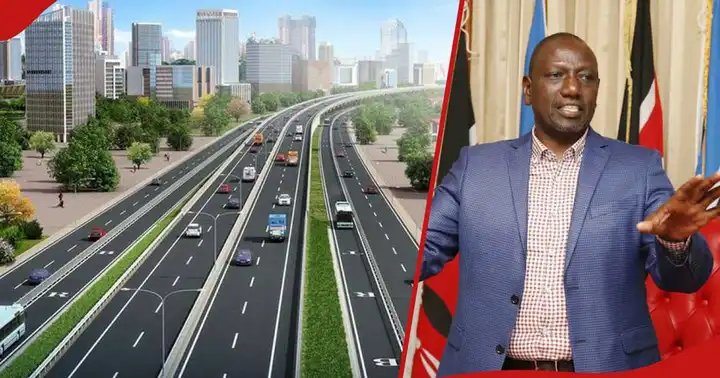
The government has announced the toll structure for the highly anticipated Rironi–Mau Summit Highway. The government awarded CRBC and an NSSF Consortium the contract for the Nairobi-Mau Summit Road. Photos: Moseax and William Ruto. Source: UGC Interior Principal Secretary Raymond Omollo revealed that motorists in small cars will pay KSh 8 per kilometre for the expressway that will cover the 56-kilometre Nairobi–Mai Mahiu–Naivasha stretch and the 175-kilometre Nairobi–Nakuru–Mau Summit section. PS Omollo emphasised that, similar to the Nairobi Expressway, improved alternative routes will be provided to ensure fairness and choice for all road users. What are the key objectives of the new highway? The announcement provides long-awaited specifics on the KSh 200 billion project, which is designed to decongest the notoriously busy Nairobi-Nakuru Highway and boost regional trade. “We are committed to ensuring this highway serves the people who rely on it every day.
Safer roads, reduced travel time, and smoother journeys are the key objectives. “Beyond convenience, this road is an investment in trade, agriculture, and access to essential services. It ensures people, produce, and goods move safely and efficiently,” he said. The new highway will feature a phased lane configuration to address varying traffic densities along the route. From Rironi to Naivasha, it will be a four-lane dual carriageway. The section from Naivasha to Nakuru, which is a major bottleneck for heavy commercial traffic, will expand to six lanes to keep goods moving efficiently. Within Nakuru City, the road will be elevated to avoid creating new congestion points in the urban centre.
Beyond Nakuru to the Mau Summit, it will revert to a spacious four-lane highway, opening up faster travel to the western parts of Kenya. “By the end of 2027, the Nairobi–Nakuru journey will no longer feel like a test of patience but a sign of real progress – a Kenya moving forward for its people,” PS Omollo said during the announcement. Why is Rironi–Mau Summit Highway considered a strategic national project? The Rironi–Mau Summit Highway is more than just a road; it is a critical trade corridor. Its primary aim is to ease the flow of goods from the Port of Mombasa to Western Kenya and onward to landlocked neighbours like Uganda, Rwanda, and the Democratic Republic of Congo. By significantly reducing travel time and improving reliability, the project is expected to lower transportation costs, strengthen supply chains for farmers and businesses, and improve Kenya’s competitiveness against alternative routes through Tanzania. The highway carries nearly 40% of the nation’s commercial traffic and serves as a key link to the western region and regional export markets.
Under the tolling framework, toll revenues will be ring-fenced for the same corridor to fund maintenance, lighting, safety patrols, and emergency response. Toll rates will be regulated, reviewed periodically, and adjusted transparently in line with economic realities, with exemptions for ambulances, military and police vehicles, and local traffic. Will there be free alternative routes on Rironi–Mau Summit Highway? Acknowledging public concerns about toll affordability, the government has assured motorists of their right to choose. PS Omollo insisted that, in line with the model used for the Nairobi Expressway, the project includes the provision and improvement of alternative, non-toll routes that run parallel to the new highway. “But Kenyans will also have improved alternative routes, because choice matters. Safety matters. Fairness matters,” the principal secretary stated. To tackle congestion at the Nairobi entry point, the government also plans to separately widen the connecting Westlands-Rironi Road to six lanes. How much will the Rironi–Mau Summit Highway contractor earn? The contractor selected to dual the Nairobi–Mau Summit Highway is projected to earn about $2.63 billion (KSh 339.8 billion) in operating profit over the 30-year concession period through toll fees, according to project details released by the Kenya National Highways Authority (KeNHA). The road upgrade, approved by President William Ruto’s administration and structured as a public-private partnership, will be undertaken by a consortium of China Road and Bridge Corporation (CRBC) and the National Social Security Fund (NSSF). The road has total projected revenues of $4.88 billion (KSh 630.3 billion) against costs of $2.25 billion (KSh 290.5 billion). Financing will be split between 75% debt and 25% equity, followed by tolling after two years of construction. The project will use electronic toll collection to minimise leakage and congestion.
Source: TUKO.co.ke