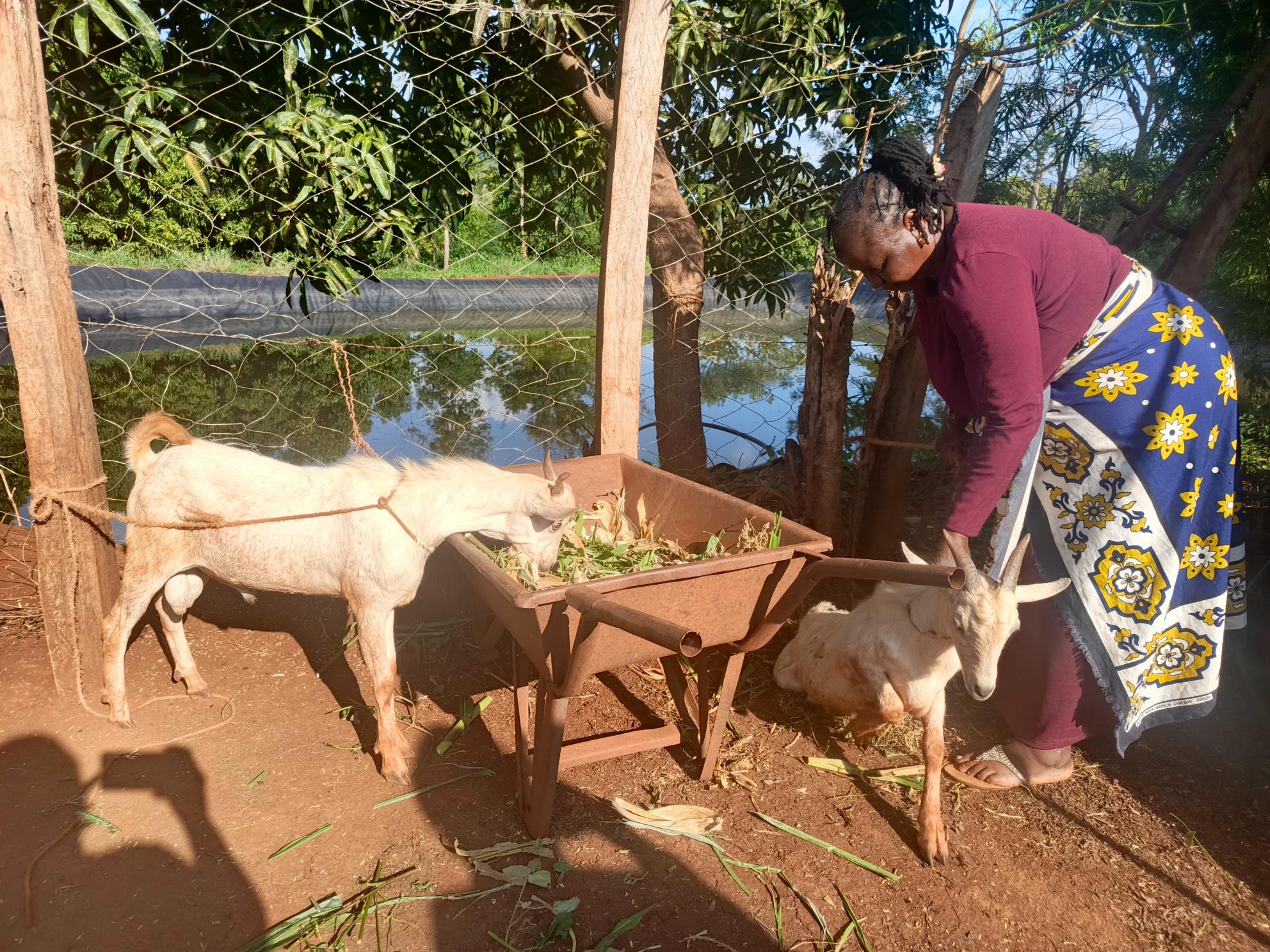
Women in Tharaka Nithi county are turning to dairy goat farming as a coping mechanism to the increasingly erratic rainfall and shrinking land sizes.
Dairy goats are helping women earn income, improve household nutrition and slowly claim their space in a farming system that has long been dominated by men.
For members of Umoja Women Self-Help Group in Tharaka South, dairy goat farming is more than a livelihood activity, it is a survival strategy.
The group, made up of 25 women and five men, came together to confront the realities of climate change, food insecurity and limited economic opportunities in their community.
“Goats were not our first choice; they were our best option,” says Purity Gatiria, the group’s coordinator. “They need little land, cope well with harsh weather and give returns much faster than other livestock.”
Unlike dairy cows, which require large quantities of feed, water and constant attention, dairy goats fit well into the lives of women juggling farming, caregiving and small businesses. They browse on shrubs and leaves, survive drought better, and start producing milk sooner.
The decision to invest in dairy goats has paid off for many members, including Doris Kanario, a widow and mother who joined Umoja after hearing about the group’s training on goat keeping.
“I was already keeping one or two local goats,” she recalls. “But I wanted to learn more and wanted to belong to something bigger. When the group accepted me, I was so happy.”
Today, Kanario owns four goats, though only one is a pure dairy breed. Like many women in the group, she struggles to maintain pure breeds due to high costs and limited access to quality breeding services.
She says a pure dairy kid below three months costs between Sh15,000 and Sh30,000. This is well beyond the reach of many rural women whose daily income comes from casual labour or selling vegetables.
“A rural woman who is not earning regularly cannot just wake up and buy a pure dairy goat,” says Kanario. “That is why we depend on the group, the merry-go-round and sometimes small loans.”
The group had initially received a few dairy goats through a support project several years ago. But with only one breeding he-goat available among many members, interbreeding quickly diluted the quality of the stock.
“We ended up mixing dairy goats with local he-goats because we had no alternatives. The milk reduces, the quality drops and the goats don’t fetch good money,” she explains.
Despite these challenges, the benefits of dairy goats remain clear. A good goat produces between one and two litres of milk a day. Kanario keeps about half a litre for her family and sells the rest to neighbours and fellow group members.
“Even selling one and a half litres at Sh100 per litre makes a difference,” she says. “Goat milk has value. And the manure is very good for my kitchen garden, it helps me reduce the use of costly and harmful agrochemicals.”
Beyond income and nutrition, dairy goats are also quietly shifting power dynamics within households. In Meru and Tharaka communities, livestock and land have traditionally been controlled by men, leaving women with little say over assets.
“In this community, livestock is male-controlled. Even when a woman gets a goat through a group, a husband can sometimes sell it without her permission,” Kanario said.
She recalls in earlier years, many women did not even possess national identity cards, locking them out of SACCOs, loans and formal group registration.
“Some husbands used to keep our IDs. But things have changed. Women now have IDs, phones and they can sign for themselves. We have claimed our space. Members save small amounts each month, sometimes as little as Sh200 through merry-go-rounds and table banking systems,” she says.
The resilience of goats is particularly valuable in a region where rainfall has become increasingly unreliable. “When it is dry, cows suffer but goats manage. They never go hungry,” Kanario said.
Their low-maintenance nature also allows women to diversify their incomes. She supplements her earnings by baking cakes and offering catering services. “A goat is the easiest animal to manage.”
According to Purity Gatiria, the group’s biggest need is access to affordable pure breeds, reliable breeding services and consistent extension support.
“We need more training,” she says. “We don’t know enough about improving our goats for better milk. If experts could guide us, we would grow fast. We love goat rearing and with the right support, we can completely change our homes.”
At a broader level, organisations such as the Women Farmers Association of Kenya (WoFaK) continue to support groups like Umoja by strengthening leadership, linking them to partners and amplifying their voices in policy spaces.
“Our mission is to help rural women farmers make informed food and production decisions, both individually and as groups,” says Daphine Muchai, WoFaK’s executive director. “We also help them sit at platforms where their voices can shape policies.”
Muchai says they link women to opportunities across various value chains, from dairy goat farming and value addition to specialised programmes for women living with disabilities. “Leadership and governance training is central to its work to ensure groups remain cohesive and sustainable,” she says.
At the local level, community leaders are seeing the impact. Emily Makembo, assistant chief of Tunyai sub-location in Tharaka South, says women’s groups have become an anchor for the community during difficult times.
“This group has grown. Women are supporting one another through farming. The dairy goat project has been especially transformative for mothers who work in the fields every day,” she says.
Milk that was once hard to find is now available within the community. “Even my mother benefits. These goats have brought mothers together. You can see it in their homes, because the children are doing well,” Makembo adds.
by AGATHA NGOTHO