

Close Menu
  • News
  • Counties
  • International News
  • Sports
  • Technology and Innovation
  • Our Forum
  • Contact Us
Facebook X (Twitter) Instagram
Trending
  • Why most Kenyans are embracing cosmetic surgery procedures
  • Woman claims to be Bahati’s biological mother, seeks forgiveness and reunion
  • Kenya’s inequality crisis in numbers: Wealth gap
  • Samsung unveils first ‘special edition’ triple-folding phone
  • KRA Orders All Petroleum Dealers to Share Invoices on Its Electronic Platform eTIMS
  • Nairobi: High Court Grants Relief to 13 Matatu Saccos, Allows Continued Operations Amid CBD Standoff
  • No glitters: Residents in gold-rich area in Kakamega reject mining company, cites rights violation
  • Jinsi Lucy alivyoimarisha biashara yake ,na kuvutia wateja
Facebook X (Twitter)
Breaking Kenya News
Leaderboard Ad
  • News
  • Counties
  • International News
  • Sports
  • Technology and Innovation
  • Our Forum
  • Contact Us
Breaking Kenya News
You are at:Home»News»Kenya’s inequality crisis in numbers: Wealth gap
News

Kenya’s inequality crisis in numbers: Wealth gap

Kevin TevBy Kevin TevDecember 2, 2025No Comments2 Mins Read
Facebook Twitter Pinterest LinkedIn Tumblr Email

Kenya’s widening wealth gap continues to expose deep inequalities, with new data highlighting the stark contrast between the country’s richest and the rest of the population.

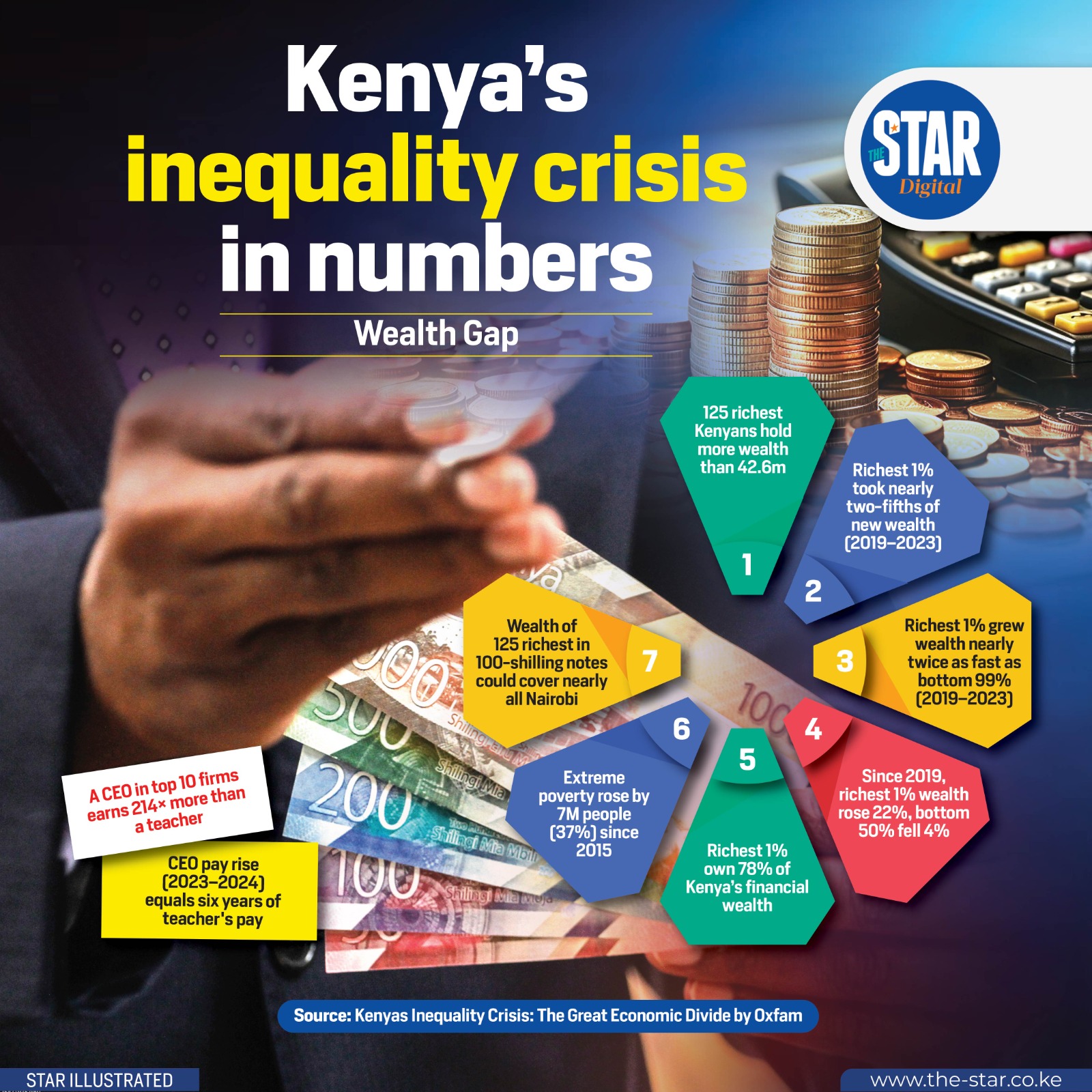
According to findings from Kenya’s Inequality Crisis: The Great Economic Divide by Oxfam, just 125 of the richest Kenyans now hold more wealth than 42.6 million people combined, underscoring how concentrated the country’s financial power has become.

The trend is driven largely by the explosive growth of wealth among the top 1 per cent. Between 2019 and 2023, Kenya’s richest 1 per cent captured nearly two-fifths of all new wealth, and their fortunes grew twice as fast as those of the bottom 99 per cent.

Over the same period, the richest 1 per cent increased their wealth share by 22 per cent, while the poorest half of the nation saw their wealth decline by 4 per cent.

Today, the top 1 per cent controls 78 per cent of Kenya’s financial wealth, reflecting an imbalance that continues to widen. This inequality is mirrored in income disparities, where a CEO in Kenya’s top companies earns 214 times more than a teacher, and the CEO’s pay rise from 2023 to 2024 alone equals six years of a teacher’s earnings.

The human cost is equally significant. Extreme poverty in Kenya has risen sharply, with seven million more people, or 37 per cent, falling into severe hardship since 2015.

Meanwhile, the combined wealth of the country’s 125 richest individuals, if stacked in 100-shilling notes, could nearly cover all of Nairobi — a powerful illustration of Kenya’s growing economic divide.


by WILLIAM WANYOIKE

Share. Facebook Twitter Pinterest LinkedIn Tumblr Email
Kevin Tev

Related Posts

I take my work seriously — Ruto explains why he did away with subsidies

Lobby boss Kamau Ngugi warns shrinking civic space to worsen ahead of 2027

Ritz Carlton Mara hotel complies with conservation laws — NEMA

Categories
  • ads
  • business
  • Counties
  • ENTERTAINMENT
  • International News
  • News
  • OPINION
  • Sports
  • Technology and Innovation
  • Facebook
  • Twitter
  • Instagram
  • Pinterest
  • Popular
  • Recent
  • Top Reviews
March 17, 2018

Barclays launches mobile loan app

February 4, 2019

Hyena mauls boy to death in Laikipia, injures father

February 16, 2019

How corruption and impunity are aiding terrorism in Kenya

December 2, 2025

Why most Kenyans are embracing cosmetic surgery procedures

December 2, 2025

Woman claims to be Bahati’s biological mother, seeks forgiveness and reunion

December 2, 2025

Kenya’s inequality crisis in numbers: Wealth gap

Facebook X (Twitter) Instagram Pinterest
  • Home
  • About Us
  • Authors
  • Contact Us
Copyright © 2025 ThemeSphere. Powered by WordPress.

Type above and press Enter to search. Press Esc to cancel.