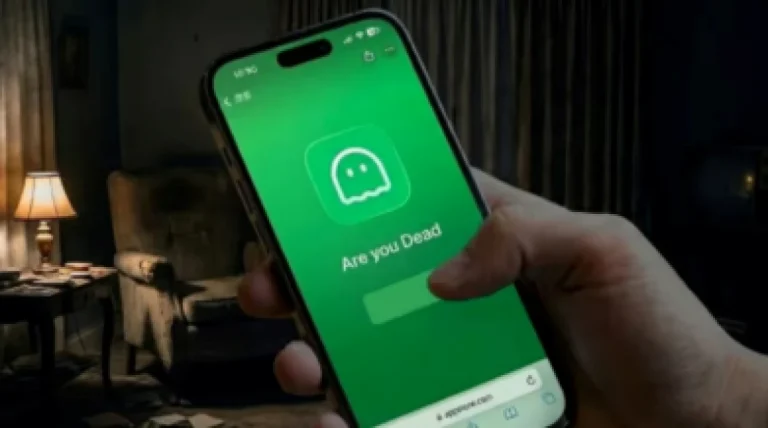


On Saturday, I pulled up my phone settings and did something I haven’t considered in almost a decade, a move so brazen I’ve spent my whole career telling people to avoid it. I gave Instagram access to my location.
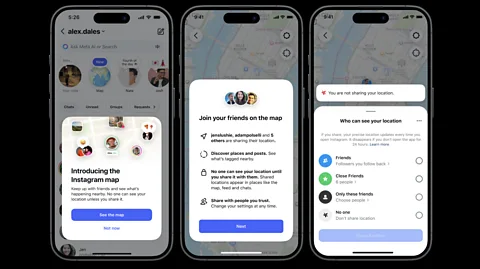
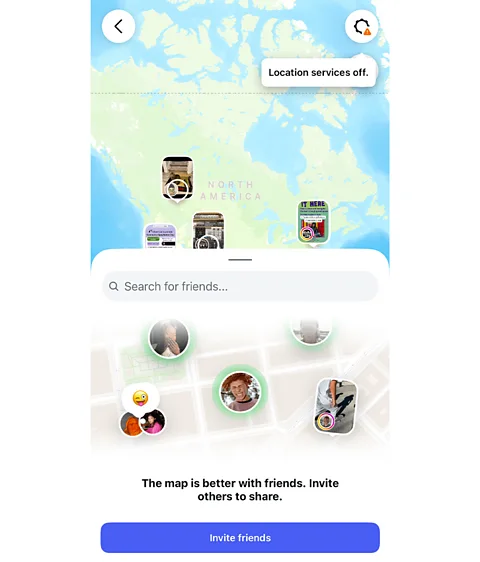
Millions of Americans were greeted by a pop-up last week inviting them to try the new “Instagram Map”. The feature lets users share their exact, real-time location with each other. If you want, you can blast your whereabouts to every single one of your mutual followers. For many, however, the app’s history makes it an unsettling place for this kind of intimacy.
Instagram bills the Map as “a new, light way to connect”. But a trip through the feature suggests a different reality, one defined more by emptiness than connection, with users unwittingly broadcasting their location and urgent warnings from the few people watching. It lays bare what may be an emerging conflict between the platform and its users that strikes at Instagram’s very core: what is this app even for?
On one hand, it’s nothing new. Apple and Android phones have let you exchange locations with your contacts for years, and Snapchat has the nearly identical Snap Map that works the same way. In modern relationships, location sharing is as popular as it is problematic. The New York Times described the trend with the catchy headline “I Love You, Let’s Stalk Each Other” back in 2023.
 Meta
MetaBut Meta, the company that owns Facebook, Instagram and WhatsApp, has a rocky history when it comes to privacy. Chief executive Mark Zuckerberg has personally apologised numerous times over the years for how his company has mishandled users’ data, problems that have cost Meta billions in fines and lawsuits. The company promises it cares about user privacy and has vowed to earn back trust.
Still, I wondered, who’s volunteering for Meta’s new social surveillance experiment? What does it feel like to expose your location to every single one of your friends on Instagram? I wanted to know, so I tweaked my privacy controls and ventured into the wilds of the Map.
My first problem was Instagram doesn’t make the Map easy to find. Several people I asked said they wanted to try it but had no idea where to look. Eventually, I found it tucked away under a globe icon in the messages tab. Instagram walked me through my options. Did I want to share location with all of my connections, the users on my “Close Friends” list or a handpicked group? It even launched a second pop-up to ask if I was sure.
As GPS satellites triangulated my coordinates, Apple routed the data through my phone and out to Instagram’s servers. A little dot with my face on it hovered precisely over my New York apartment. I felt, for a second, a strange pang of vulnerability.
It was even stranger to realise that I was almost completely alone. I expected to find at least a few other brave souls on the Map, but for all my hundreds of Instagram connections, exactly one other person was using the feature, across the continent in Los Angeles.
It was a guy named Highland Hall, an old colleague from the record store I worked at before college. Hall and I weren’t close at the time, and a third of my life has passed since the last time we spoke. I sent him a DM. The Map was helping us connect, exactly what Instagram says it’s intended to do.
“I feel like you used to be able to see posts by location, like, years ago, it was a fun feature,” Hall said. “I pretty much wanted to see what the feature was, and was pretty much disappointed. Lol.”
I said I was surprised to see there was no one else using the Map. Are my friends and I just too old, aging out of the target demographic? Or perhaps I’m unpopular, and everyone is joyfully sharing locations without me. You never know. Whatever the truth, I told Hall the whole thing seemed a bit lonely. “Like all social media,” he said.
Hall said the privacy issues didn’t bother him. “I feel like they have that data already. I tend to post a week or so later, so it’s never where I actually am at the moment.”
But he was mistaken. I explained that he was in fact sharing exactly where he was at the moment. “I didn’t zoom in because I assume this is your house,” I said.
The revelation sparked a long pause before Hall wrote back. “I just turned it off,” he said.
Hall isn’t the only one confused by the new function. Adam Mosseri, head of Instagram, spent the weekend playing damage control with outraged users on Threads, the company’s answer to X, the app formally known as Twitter.
Whether or not you choose to share your live location, all your public photos, videos and Stories show up on the Map if you’ve tagged locations in those individual posts. Apparently, a lot of people saw this and thought Instagram was collecting new data without their permission.
I scrolled through dozens of Mosseri’s responses to these complaints, which seemed more exasperated as time went by. “That’s not true,” Mosseri said in response to a now-deleted complaint. “You can opt-into sharing your location if you want to, but we never share someone’s location unless they decide to share it.”
 Meta
MetaA spokesperson for Meta told me that the Map is turned off by default, and only people you follow back can see your location unless you choose to narrow the list even further. My friend, they said, must have opted in to sharing his location during the Map’s onboarding process.
“It’s like they don’t understand their user base at all,” says Hannah Law, a 26-year-old Instagram user who works as a geotechnical engineer in Salt Lake City in the US. “Instagram isn’t an intimate app where you would want people to know your location.” The feature seems based on Snapchat’s Map, she says, but Snapchat feels geared for more guarded personal connection. “Instagram was born and bred as a broadcasting service for your life. I’m much more likely to get stalked by an Instagram follower than a Snapchat friend.”
Meta’s spokesperson stressed that users have control over who sees their location, and said parents who set up supervision tools get notifications when teens turn the feature on.
“People have always come to Instagram to share what they’re up to and where they are,” Meta wrote in a blog post. “No matter how you use the map, you and your friends have a new, lightweight way to connect with each other.”
In recent years, Meta has encouraged a transition from posting in public to sharing messages in private. Mosseri describes the change as a “paradigm shift” which reflects how users are behaving across the social media landscape, rather than some top-down push from the company.
“There’s definitely a shift in how people are using social media, especially younger people. This location-sharing seems like a natural extension of this,” says Lorrie Cranor, who studies app interfaces as a professor of privacy, security and public policy at Carnegie Mellon University in the US. “But Instagram doesn’t seem designed to lend itself to that smaller group experience. I question whether people really want their Instagram friends to know that much about them 24-7. And in general, features on social media that allow people to track each other are often problematic.”
The first thing we’d say is turn it off. The safety concerns are a real issue, and there’s a real potential for misuse – Robbie Torney
Some experts fear these tools may bring on mental health and social problems. For example, a study from the child advocacy group Common Sense Media found that 45% of adolescent girls said location sharing had a “mostly negative” effect on them.
“We’re not an organisation that is explicitly anti-social media, because kids tell us there’s a variety of benefits,” says Robbie Torney, senior director of AI programs at Common Sense Media. “But kids have told us locating sharing creates social pressures about where they go, fear of missing out and worries about whether their friends are hanging out without them. It can make it more challenging to fit in, creating pressure to signal that you’re part of the group, and making it easier to signal that you’re not part of the group.”
It’s not just children who face that sort of problem. I’ve heard a number of unpleasant stories from people who use Apple’s “Find My Friends” location-sharing feature. Awkward questions crop up when someone doesn’t get a party invitation. A jealous ex shows up at the bar. An unsettling friend pays a little too much attention to what you’re up to. And when problems arise, revoking someone’s access to your location may come with social consequences.
“The first thing we’d say is turn it off,” especially if you’re a parent monitoring your child’s internet use, Torney says. “The safety concerns are a real issue, and there’s a real potential for misuse.”
Location information is probably the most sensitive type of data that’s regularly siphoned out of your phone. Your daily movements can reveal where you live, where you work, who you spend time with, even where your children go to school. Go to a specialist’s clinic, and it can expose your medical conditions. Attend a protest, and it documents your political beliefs. Visit a gay bar, and your location data carries implications about your sexuality. It’s also, of course, incredibly valuable to companies that make their money on advertising, such as Meta, allowing them to target you with local advertising and make more assumptions about who you are and what you’re like.
by Thomas Germain